
The Forester wins on visibility and trailhead parking. The Outback wins on cargo, towing, and road-trip range. Which one you actually want depends on what "outdoor adventure" looks like for your weekend.
The short version
- Both carry standard Symmetrical All-Wheel Drive and EyeSight on most trims from 2019 onward.
- The Forester is the smarter pick for tight forest access roads and solo/couple camping trips where cargo fits behind two seats.
- The Outback carries significantly more gear seats-down (up to 80.5 cu ft on the 2020-2026 generation vs. up to 74.4 on the comparable Forester), tows a kayak trailer or small boat with the 2.5L engine, and handles a longer Alabama road trip more comfortably.
- Ground clearance is 8.7 inches on standard trims of both; the Wilderness editions go higher on both models, and those are worth hunting on the used market.
- Our team's honest take: the Outback is the better one-vehicle solution for most Birmingham-area outdoor families. The Forester earns its spot for buyers who prioritize parking ease and everyday efficiency over maximum hauling.
What's the Real Difference Between These Two?
Both of these wagons share more DNA than the badges suggest, and the gap that matters sits in just three places for Alabama use. They run the same Symmetrical AWD, the same BOXER engine family, and the same EyeSight safety suite, yet they split on cargo volume, towing capacity, and how each takes the terrain about an hour east of Birmingham on I-20.
The specs diverge in a handful of spots on the used generations most buyers are shopping right now (2019-2024 Forester, 2020-2026 Outback):
| Use Case | Forester (2019-2024) | Outback (2020-2026) |
|---|---|---|
| Cargo, seats up | ~27.5 cu ft | ~32.5 cu ft |
| Cargo, seats down | ~74.4 cu ft | ~75.2-76 cu ft (up to 80.5 on redesigned 2026) |
| Ground clearance (standard trims) | 8.7 in | 8.7 in |
| Ground clearance (Wilderness) | 9.2 in (2025) / 9.3 in (2026) | 9.5 in |
| Towing (2.5L, properly equipped) | 1,500 lb | 2,700 lb |
| Towing (turbo / Wilderness, properly equipped) | 3,500 lb (Wilderness only) | 3,500 lb (XT/Wilderness) |
| EPA highway MPG (2.5L) | ~33 mpg | ~32 mpg |
| Best for | Access roads, visibility, efficiency | Gear hauling, towing, road trips |
The Outback's 2.5L tow rating of 2,700 lb (properly equipped) means it can pull a loaded kayak trailer or a small aluminum fishing boat (something the standard Forester 2.5L simply cannot do at its 1,500 lb rating).
Does Towing Capacity Actually Matter for Alabama Outdoor Buyers?
Towing matters more for Alabama buyers than a quick glance suggests, though the Forester's roof rack still covers plenty of trips just fine. A loaded tandem kayak trailer with two boats and gear runs 400 to 800 pounds. A small jon boat or aluminum fishing boat with a basic trailer sits in the 700 to 1,200 pound range. Both stay well within the 2020-2026 Outback's 2,700 lb rating with the naturally aspirated 2.5L engine (properly equipped). That same load puts you at or past the Forester 2.5L's 1,500 lb ceiling.
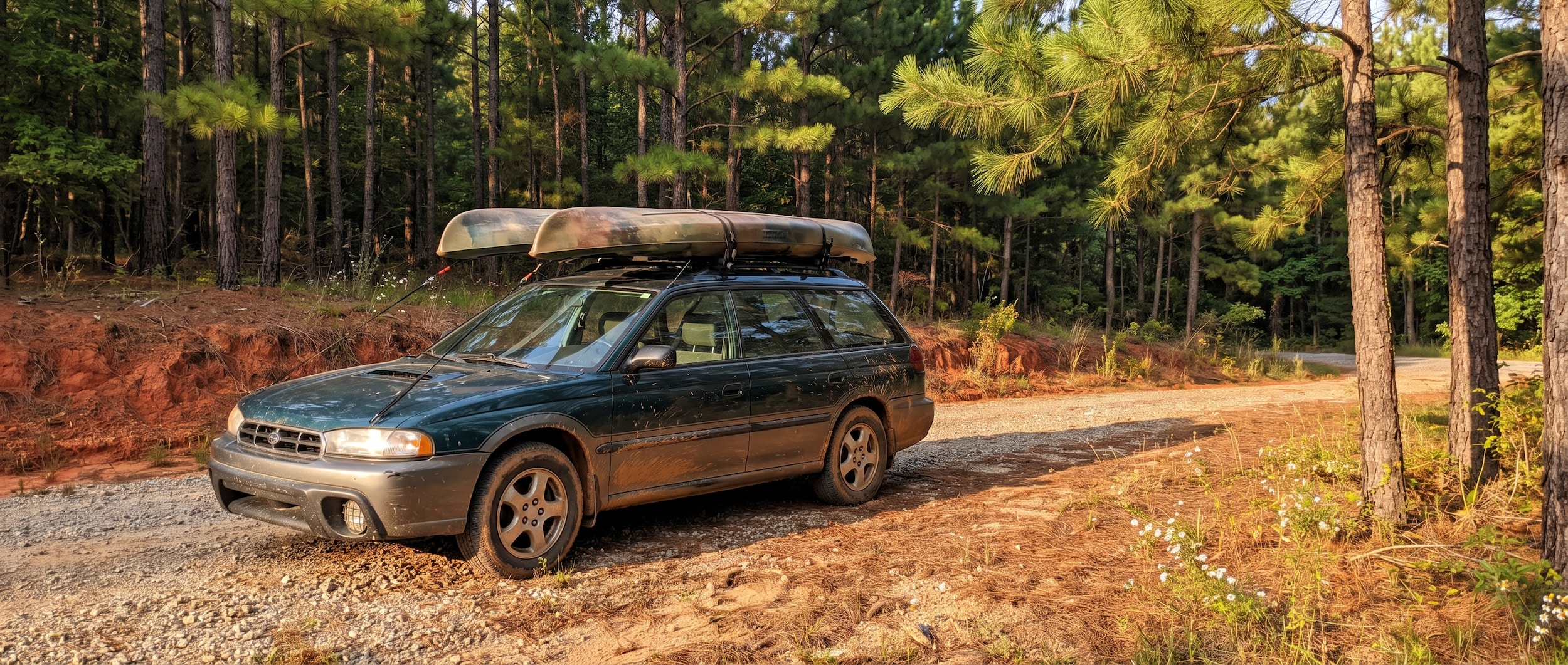
The Forester isn't helpless here. Stack two kayaks on the roof with a Yakima or Thule rack, haul your camping gear inside, and you've solved the problem. Still, that's a workaround. Run Cheaha State Park or the boat launches along Lay Lake and want to tow rather than roof-carry, and the Outback is the straightforward answer.
See used Outback options Search our pre-owned inventory
Cargo and Comfort on the Alabama Outdoor Circuit
Cargo and comfort favor the Outback once you're loaded, though both wagons reach the trailhead without complaint. Talladega National Forest stretches over 392,000 acres of central and eastern Alabama, and a lot of its access runs on gravel and forest service roads. Cheaha Mountain sits inside its southern ranger district. The access roads to Coleman Lake, the Pinhoti Trail trailheads, and the Kentuck ORV area are paved part of the way and gravel the rest. Both the Forester and Outback handle those roads with confidence on standard 8.7 inches of ground clearance, which clears the ruts and loose rock you'll actually encounter without requiring a Wilderness trim.
Where they diverge is how much fits in the back once you've driven in.
The 2020-2026 Outback's cargo bay is wider between the wheel housings than the Forester's, and the load floor is lower, which makes stacking coolers, dry bags, and folding camp chairs faster and less awkward. Subaru also fitted that generation of Outback with roof rails as standard equipment on most trims, supporting up to 165 pounds of roof-mounted gear (check the spec for the specific trim year you're shopping). The Forester's flat load floor is genuinely good, just shorter and narrower when you're fitting two people's gear for a three-night trip.
"Designed to optimize traction in rain, snow, and on rough roads, this system constantly evaluates acceleration, braking, and cornering in real time to continuously deliver power to all four wheels." (Subaru, on Symmetrical All-Wheel Drive, subaru.com)
All-wheel drive like that earns its keep on Alabama's summer dirt and gravel after a rain. The afternoon thunderstorm pattern across central Alabama from June through September means forest roads are often wet or soft when you arrive. Both vehicles manage it. Neither will get you to a spot that needs real four-wheel drive with lockers, no getting around that. Know that going in.
The Case for a Used Forester Anyway
The Forester makes a strong case for the right buyer, even though it isn't the do-everything pick for outdoor-focused Alabama drivers who want one vehicle to cover it all. It tows less, carries a bit less with the seats down, and gives up cargo width, and that's the honest concession up front.
So why pick one anyway? A few solid reasons hold up. The Forester's upright glasshouse design gives the driver exceptional outward visibility, which pays off when you're threading a gravel two-track with trees close on both sides. Parking at trailheads (including tight spots at Cheaha) is easier in a Forester's smaller footprint. The nearly vertical rear tailgate makes loading gear into the cargo bay easier at a parking lot or campsite than the Outback's more raked hatch. And the EPA-estimated 26 city / 33 highway on the 2026 Forester (with the 2.5L) translates to real-world efficiency for the I-20 corridor commute the rest of the week.
If you're a solo hiker or a couple, the Forester carries everything you realistically pack for a weekend. The extra cargo volume of the Outback only becomes load-bearing when a third person's gear enters the picture, or when you're towing.
So Which Should You Pick for Alabama Outdoor Life?
Which one to pick comes down to how many people and how much gear you move, and here's how we'd sort it by buyer profile. The Outback suits the gear-hauler and the tower, while the Forester rewards the solo hiker and the commuter.
Pick a used Outback if you: haul gear for more than two people, tow a kayak trailer, fishing boat, or small camper trailer at least occasionally, plan longer road trips across Alabama or into the Tennessee foothills, or want maximum flexibility in a single vehicle. The 2020-2026 generation hits the sweet spot on the used market. The 2.5L base engine is reliable and fuel-efficient, the XT turbo gives you genuine pulling power, and Wilderness trims that surface on the pre-owned lot bring 9.5 inches of ground clearance and dual X-MODE for the times the forest road gets rutted after a heavy rain.
Pick a used Forester if you: prioritize visibility and parking ease, do most of your outdoor running solo or as a couple, prefer a slightly smaller SUV for the Birmingham commute and mountain errands, and value the tall, easy-load cargo area for bikes, kayaks on a roof rack, or gear that stacks rather than spreads.
Both are worth putting through your inspection checklist. On the lot, we look at head gasket history on earlier BOXER engines (the 2.5L FB-series engine in 2012-2018 models was the one to watch; the 2019-and-later FA-series addressed the issue). EyeSight camera calibration, CVT fluid service history, and roof rail anchor condition on high-mileage outdoor examples also show up in our checks. The 2019-and-later Forester and the 2020-and-later Outback are the generations we'd focus on. Start there.
Frequently Asked Questions
Does the used Subaru Forester or Outback handle Alabama forest service roads better?
Both the Forester and Outback share 8.7 inches of ground clearance on standard trims, which handles the gravel and dirt forest service roads across Talladega National Forest without trouble. The practical difference shows up in Wilderness trims: a used Outback Wilderness reaches 9.5 inches of clearance, while a used Forester Wilderness (2026 model year) reaches 9.3 inches. For the gravel access roads that lead into Cheaha State Park and the Pinhoti trailheads, either standard trim is capable. If you're targeting rougher or rutted seasonal roads, hunting a used Wilderness trim on either model is worth the search.
Can a used Subaru Outback tow a kayak trailer or small boat in Alabama?
Yes, with an important detail on which engine is under the hood. The 2020-2026 Outback with the naturally aspirated 2.5L engine is rated to tow 2,700 pounds when properly equipped. The turbocharged XT and Wilderness trims are rated to tow 3,500 pounds when properly equipped. A loaded tandem kayak trailer or a small aluminum fishing boat with trailer typically falls well within that range. The standard Forester 2.5L is rated at 1,500 pounds, which leaves less headroom for trailer, boat, and gear combined. If towing is part of your Alabama outdoor routine, the Outback's rating is the more practical choice.
What's the difference in visibility between the Forester and Outback for trailhead access?
The Forester's upright glasshouse design offers exceptional outward visibility, which is particularly valuable when threading narrow gravel forest service roads with trees close on both sides. Its smaller footprint also makes parking at tight trailhead lots (like those at Cheaha) easier. The Outback carries more gear and towing capacity but has a more raked windshield and larger overall profile.
Categories:
Social