
By the Hallmark Subaru Birmingham Team | September 2026
The word people hear is "certified" and the thing they picture is a sticker. What it actually describes is a process with a pass-fail rule attached: Subaru sets the standard, a factory-trained technician works the vehicle through a 152-point inspection, and anything that does not meet the standard has to be repaired, reconditioned or replaced before the vehicle is allowed to carry the badge. A car that still has an open item is not a certified car.
Certification is not a grade. It is a gate. The vehicle either meets every point or it does not get certified, and what you are buying is that the checking already happened rather than waiting for you to discover it.
The Ascent is a useful example, because a three-row family vehicle is exactly where an unverified history costs the most: it carries the most people, does the most miles, and hides the most wear in places nobody checks on a twenty-minute drive.
How does the inspection actually work?
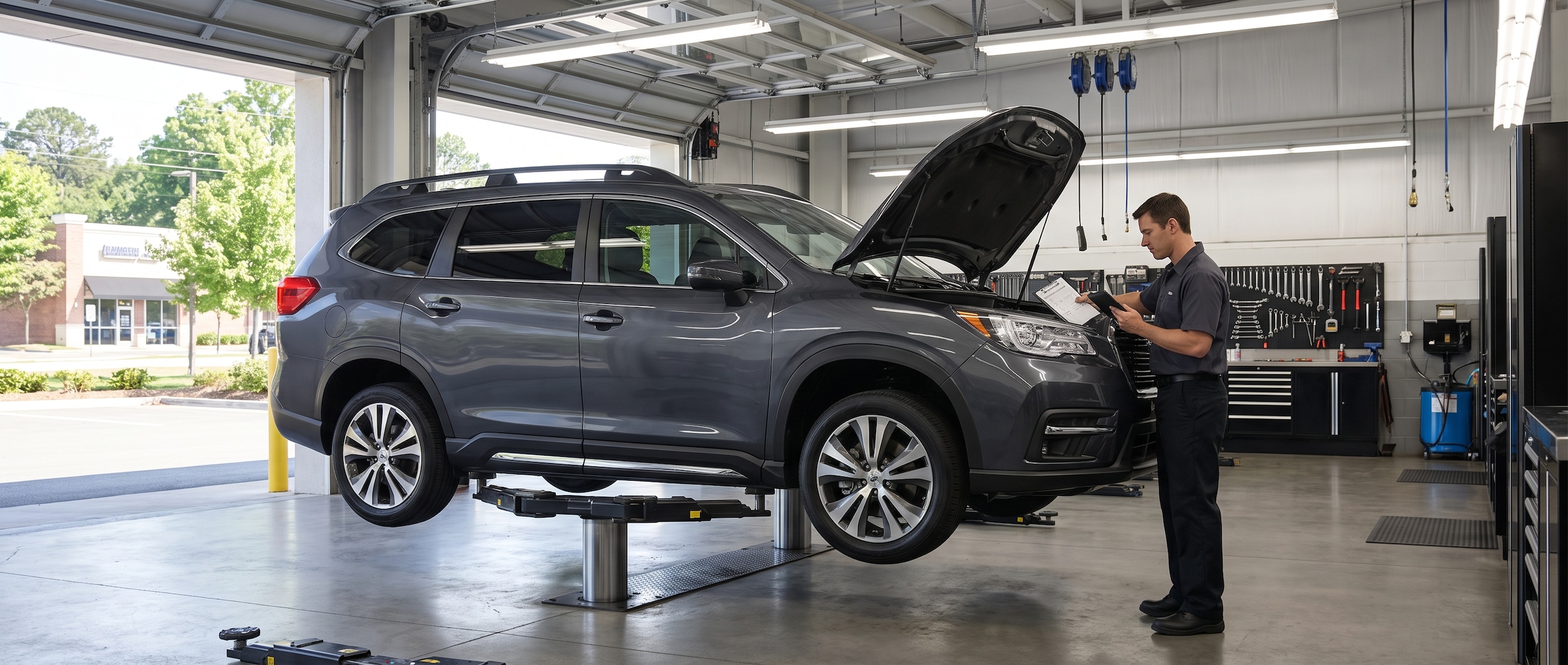
Subaru requires 152 inspection points before a vehicle can be certified, and the list is organized into four areas rather than run as a spot check. Three of those points are where a Subaru differs from anything else on a used lot.
| Area inspected | What gets checked inside it |
|---|---|
| Engine compartment | Fluid levels, filters, belts, the battery and its condition under load |
| Electrical and cabin | Audio and power equipment, air conditioning and heater function, the defogger, cruise control, the moonroof |
| Drivetrain and chassis | Transmission operation, brakes, the exhaust system, tires and tire pressure |
| Interior and exterior | Cosmetic condition inside and out, panel and trim condition, wiper blades |
Three of those checks are Subaru-specific and worth knowing by name, because they are the parts a generic used-car inspection is least equipped to judge. The symmetrical all-wheel-drive driveline runs power to all four wheels continuously, so its condition is a drivetrain question rather than an option-box question. The horizontally opposed boxer engine sits differently in the bay than an inline four, which changes what a fluid-leak inspection is actually looking at. And the continuously variable transmission behaves nothing like a conventional automatic, so "transmission operation" on this checklist means something specific.
The number matters less than the rule attached to it. Per Subaru's program, an item that does not pass has to be repaired, reconditioned or replaced before certification, which is a different outcome from disclosure. On a regular pre-owned vehicle the inspection produces a report and anything found is disclosed to you as a condition of the car. On a certified vehicle it produces a work order. That is the whole difference.
What comes with the vehicle, beyond the vehicle?
Three things, and Subaru specifies all three as part of the program rather than leaving them to the dealership.
- A complete CARFAX report, including the CARFAX Buyback Guarantee. The history is handed to you up front, which is the opposite of how used-car history usually surfaces.
- Roadside assistance, around the clock. The specifics live on the Subaru program page rather than here, but the practical point is that it travels with the car rather than with a separate arrangement you have to remember.
- Trial access to the connected services, including a SiriusXM trial and a MySubaru trial that carries the Safety Package with Automatic Collision Notification.
The CARFAX piece is usually the one that changes the conversation in Birmingham, and the reason is climatic rather than sentimental. A car that has spent four Alabama summers parked outside carries heat history in its battery, its cooling system and its interior trim, and none of that shows on a clean exterior in September. A disclosed history plus a corrected inspection list is a materially better position than a good feeling on a test drive.
If you want to see how a specific Outback or Forester came through its inspection, ask. We would rather walk you through the work order than tell you it passed.
A mini-glossary, because these three get mixed up constantly: Used is any pre-owned vehicle, sold in the condition it is in, with findings disclosed. Certified Pre-Owned is a used vehicle that cleared Subaru's eligibility rules and the 152-point inspection, with every failed item corrected first. Dealer certified is a label some lots apply using their own standard. It is not the same thing, and only Subaru can certify a Subaru.
That last distinction is worth carrying into any lot, not only ours. If the word "certified" appears without the manufacturer's name in front of it, ask whose standard it refers to.
What this means for your next Subaru
It narrows the question from "is this a good car" to "which of these verified cars suits me", which is a much easier question to answer well.
If you already know the model you want, certification lets you shop on configuration and condition rather than on risk. If you are between models, it lets you compare two vehicles that have both cleared the same bar, so the difference you are weighing is genuinely the vehicle rather than its unknown past. And if you find a Subaru you love that is not certified, that is not a warning sign on its own. It may simply have fallen outside the eligibility rules on age, mileage or a previous accessory installation. Ask which one, and you will know exactly what you are deciding about.
Ask to see the completed inspection record on any certified Subaru you are considering here. It exists, it is specific to that vehicle, and reading it is the fastest way to understand what certification bought on that particular car rather than in general. Everything certified we have on the ground sits on our pre-owned inventory page.
Common questions about certified Subaru vehicles
Is a certified pre-owned Subaru different from a dealer-certified used car?
Yes, and the difference is whose standard applies. Certified Pre-Owned is Subaru's program with Subaru's rules: the vehicle has to clear the eligibility requirements and pass a 152-point inspection performed by factory-trained technicians, and every item that does not pass has to be repaired, reconditioned or replaced before certification. A vehicle described as "dealer certified" has been checked against a standard that dealership set itself, which may be thorough but is not the same thing. Only Subaru can certify a Subaru.
What happens if a vehicle fails part of the 152-point inspection?
It gets corrected, or the vehicle does not get certified. That is the rule that makes the process meaningful. A failed item becomes work that has to be completed, so the car you eventually see has already had those repairs, reconditioning or replacements done. If the vehicle cannot be brought up to standard, it is sold as a regular pre-owned vehicle instead, with its condition disclosed, and that is a legitimate thing to buy as long as you know which of the two you are looking at.
Categories:
Social