
You found a used Outback or Forester at a decent mileage and the pictures look clean. Here's the honest truth: a DIY walkaround catches the obvious stuff, but Subaru's known failure points (head gasket residue, CVT shudder, EyeSight calibration drift) show up only under the right conditions and with the right tools. Knowing which inspection catches which problem is the actual decision a used-Subaru buyer has to make.
Browse our used Subaru Outback inventory
The short version
- A DIY walkaround is fast and free and rules out clear no-buys (rust, collision repair, oil weeping at the block)
- A Subaru dealer pre-purchase inspection adds a scan tool, a CVT fluid pull, a differential fluid check, and an EyeSight camera calibration test, none of which you can do at the curb
- The known failure windows on used Subarus are model-year-specific: head gaskets (EJ25 engines, 1999-2010 on naturally aspirated 2.5L models), oil consumption (FB engines, certain 2011-2014 models), and CVT shudder (most CVT Subarus 2013-2019)
- Alabama heat and humidity add one more variable: CVT fluid degrades faster under sustained high operating temperatures, and EyeSight camera moisture is a documented failure mode in humid climates
- Our recommendation: do the walkaround first to rule out hard no-buys, then pay for the inspection on anything that survives it
What's the Real Difference Between the Two Inspections?
A DIY walkaround is what any informed buyer can do with their eyes, their nose, a cold start, and twenty minutes. It costs nothing and it works. A pre-purchase inspection at a Subaru service center adds diagnostic tools and fluid analysis, things that are invisible at the curb. They're not substitutes for each other. They're sequential.
| Inspection Type | What It Catches | What It Misses | Time / Cost |
|---|---|---|---|
| DIY walkaround | Oil weeping at block seams, coolant smell, CVT shudder feel, body filler, mismatched panel gaps | Internal CVT wear, actual fluid condition, EyeSight calibration, open recalls | 20-30 min / free |
| Subaru dealer pre-purchase inspection | Diagnostic trouble codes, CVT and differential fluid condition, EyeSight camera function, all open recalls by VIN | Nothing that a dealer tech can access | 1-2 hrs / varies |
| What neither catches alone | Full service history gaps, prior oil consumption test documentation on affected FB engines | Get this from the seller in writing before you start either inspection |
The head gasket, oil consumption, and CVT failure windows on used Subarus are generation-specific and map to exact model years, knowing the window before you inspect changes what you're looking for.
Which Model-Year Subarus Deserve the Closest Attention?
The answer depends almost entirely on which engine generation is under the hood. Two distinct failure histories circulate in the used Subaru market, and both are worth knowing before you walk up to a car.
Head gasket risk (EJ25 naturally aspirated 2.5L engine). The non-turbo EJ25 2.5L engines used in the Outback (2000-2009), Forester (1999-2010), Legacy (2000-2009), and Impreza (1999-2011) carry a documented external oil and coolant seep at the head gasket, typically appearing between 120,000 and 150,000 miles. Turbo models and the 3.6L H6 are not in the same risk group. The fix works, but you want to know if it's been done. During your walkaround: with the engine cold, look at the seam between the block and the cylinder head on both sides. A brown residue or a small coolant stain is the tell. Also pull the oil dipstick and check for a milky color or a sweet smell from the coolant reservoir.
Oil consumption (FB engine, certain 2011-2014 models). The FB engine generation replaced the EJ25 and solved the head gasket issue. It introduced a different one. According to the class action settlement, the affected vehicles are the 2011-2014 Forester (2.5L), 2013 Legacy and Outback (2.5L), and 2012-2013 Impreza and 2013 Crosstrek (2.0L). On these, ask the seller for documentation of an oil consumption test or engine repair. A short-block replacement under settlement repair procedures is actually a positive, it means the engine was addressed. No paperwork at all on a high-mileage example from this generation is a reason to keep looking.
View our Forester listings or browse available Crosstreks
What 2015 and newer looks like. Ring revisions mid-production addressed the oil consumption issue. Cars from approximately 2015 onward on the FB engine are in a much cleaner spot, the known structural problems are behind them. This is also when EyeSight became standard on more trims, which introduces its own inspection item (below).
Schedule a Pre-Purchase Inspection
CVT Behavior and Fluid Condition: The Test That Happens on the Drive
Subaru's Lineartronic CVT appears in almost every model from 2013 onward. Most of them are fine. Some develop a shudder (a vibration or rumble that owners describe as driving over rumble strips on smooth pavement) occurring between about 15 and 25 mph. This happens when the torque converter lockup clutch engages and disengages abnormally at low speeds.
You can feel it on the test drive. Here's what to do: leave the lot cold, accelerate gently from a stop to about 30 mph, and pay attention to the 15-25 mph band specifically. A smooth, linear pull means the torque converter is locking cleanly. A shudder or vibration in that speed range is worth noting. Then listen at highway speed for a whining or humming sound that changes pitch with vehicle speed (not with engine RPM). That pitch change is a sign of CVT bearing or chain wear, not tire noise.
At a dealer inspection, the technician pulls the CVT fluid and checks it. Dark, burnt-smelling fluid is the clearest indicator of a transmission that has been running hot or neglected. Alabama's long, hot summers (where daily temperatures from June through August regularly push into the mid-to-upper 90s) accelerate CVT fluid degradation in vehicles that spent their lives here. A car that commuted into Birmingham on I-20 in stop-and-go traffic during a July afternoon is harder on that fluid than the same mileage on a cooler highway in a different climate. That's not a reason to avoid Alabama-market cars. It's a reason to check the fluid.
EyeSight Camera Condition in Alabama's Humidity
EyeSight, Subaru's stereo-camera driver assist system, is one of the most useful features on a used Subaru, and one of the most humidity-sensitive. The system uses two cameras mounted at the top of the windshield. When the seals age or the cameras take minor windshield impacts, moisture can enter the housing. A clouded or fogged camera lens won't pass calibration and may disable the pre-collision braking function entirely.
NHTSA issued recall WQS-54 covering 2015 Legacy, Outback, Impreza, and XV Crosstrek models with EyeSight, as well as 2016 WRX, for a brake-light switch failure that could prevent automatic pre-collision braking from operating. The remedy was a reprogramming at no cost. On any used Subaru with EyeSight from these model years, look up the VIN on the NHTSA recall portal before you hand over a deposit.
Per NHTSA recall WQS-54: a faulty brake-light switch on certain 2015 and 2016 Subaru models equipped with EyeSight could prevent the automatic pre-collision braking component from functioning as intended.
Walk around to the inside of the windshield and look at both camera housings directly. Cloudiness, condensation, or discoloration inside the lens housing means the camera will likely need replacement, not a software update. Our service team tests EyeSight function as part of any pre-purchase inspection, including a calibration check that requires specific targets and cannot be done in a parking lot.
Get an EyeSight inspection before you buy
The Differential Fluid Question That Sellers Can't Answer
Here's something that trips up even experienced used-car buyers. Subaru's Symmetrical All-Wheel Drive system runs three separate differential fluid chambers (front, center through the CVT on most models, and rear). Subaru's maintenance schedule calls for inspection every 30,000 miles. Most sellers have no idea whether this was ever done.
Dark, murky differential fluid or fluid with metal particles on the drain plug magnet is the sign of a system that has been running without maintenance. A whining or howling sound from the rear, especially when accelerating or turning, points the same direction. Neither of these shows up in a driveway inspection. A technician pulls the plugs and checks the fluid condition directly, and the rear differential is straightforward to access on a level surface.
This matters more on a Subaru than on a front-wheel-drive vehicle precisely because the AWD system is always engaged. There's no part of the drivetrain that's just along for the ride. Neglected differential fluid is a three-part problem on these cars, not a one-part problem. The good news: a differential fluid service is a straightforward fix if caught early.
So Which Inspection Should You Do?
Do both. In that order. Here's how we'd walk a buyer through it.
If the car fails the DIY walkaround, stop. Signs of a head gasket seep on a high-mileage EJ25, oil consumption evidence with no repair documentation on an affected FB model, a CVT shudder you can feel clearly in the 15-25 mph range, or panel gaps that tell a collision story (any of these is a reason to keep looking before you spend money on a paid inspection).
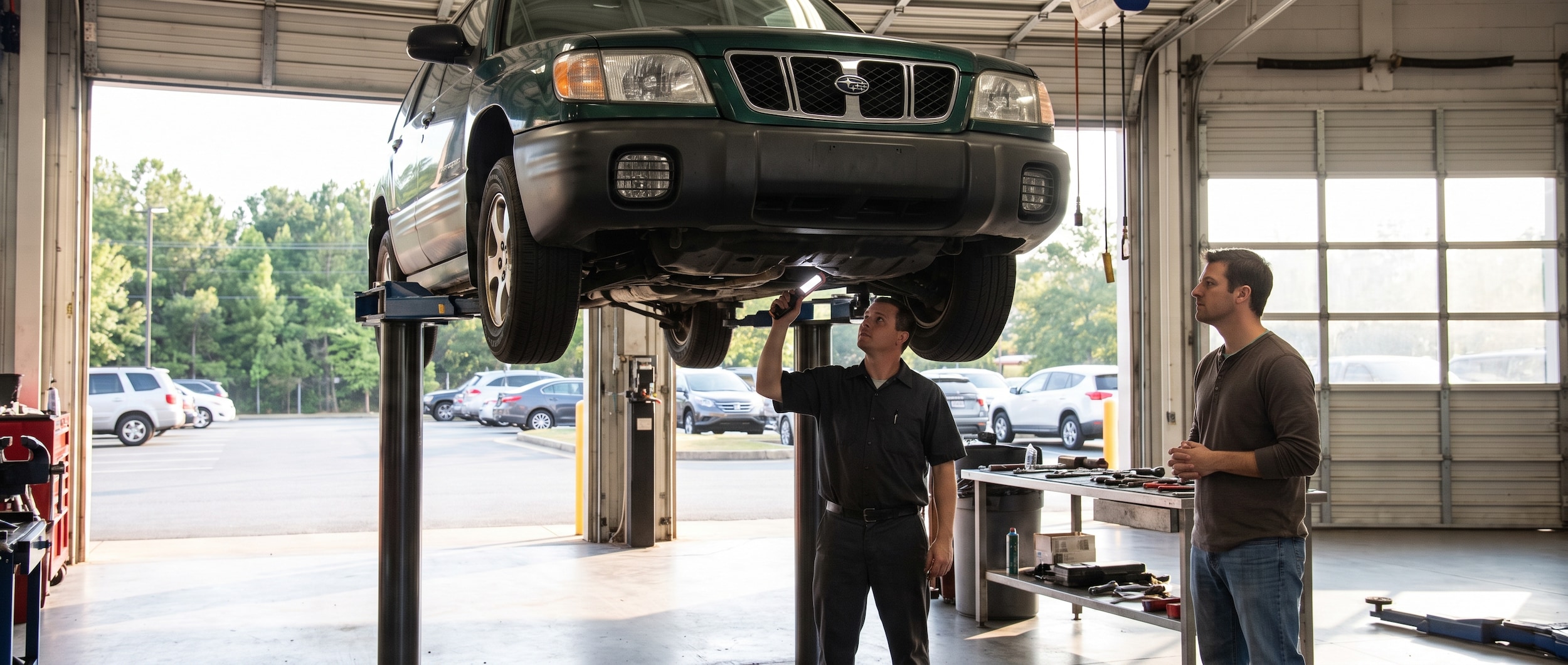
If the car passes the walkaround, get the dealer inspection. This is where a Subaru technician pulls codes, checks every fluid chamber, tests EyeSight calibration, and runs the VIN against all open NHTSA recalls. It's the step that catches what's invisible at the curb.
Buyer profile by scenario:
- You're looking at a 2015-2021 Forester, Outback, or Crosstrek with under 80,000 miles and a clean Carfax. The major generational issues are mostly behind these cars. The walkaround clears fast. Pay for the inspection and you're probably buying well.
- You found a 2012-2014 FB-engine car with high mileage and no oil consumption paperwork. That's a harder ask. The inspection matters even more here, specifically the oil consumption history and the CVT fluid condition.
- You're looking at anything with the EJ25 non-turbo engine from the 2000-2010 era at over 100,000 miles. Ask directly whether the head gaskets have been replaced. Proof of the repair done correctly is a green flag, not a red one. No answer and no records on a car above 120,000 miles is the red flag.
Frequently Asked Questions
What are the most common problems to check on a used Subaru?
The two generation-specific issues to know are: the external head gasket seep on non-turbo EJ25 2.5L engines (Forester 1999-2010, Outback and Legacy 2000-2009, Impreza 1999-2011), which typically surfaces above 120,000 miles; and oil consumption on certain FB-engine models (2011-2014 Forester, 2013 Legacy and Outback, 2012-2013 Impreza and 2013 Crosstrek), which was the subject of a class action settlement. CVT shudder between 15 and 25 mph is a third item on any CVT-equipped Subaru from 2013 onward. Pull the NHTSA recall portal with the VIN to catch any open campaigns (especially the EyeSight brake-light switch recall WQS-54 on 2015-2016 models).
Does the EyeSight system require special inspection before buying a used Subaru?
Yes. EyeSight relies on two stereo cameras mounted at the top of the windshield, and moisture inside the camera housing (something Alabama's humidity accelerates) can prevent the system from calibrating correctly and disable the pre-collision braking function. Checking the lenses for internal cloudiness is something you can do visually, but a proper calibration test requires dealer equipment and specific targets. Any used Subaru with EyeSight should have its VIN checked against NHTSA recall WQS-54 (covering certain 2015 Legacy, Outback, Impreza, XV Crosstrek, and 2016 WRX models) before purchase.
What does a dealer pre-purchase inspection cover that I can't check myself?
A dealer inspection includes a full diagnostic scan, CVT and differential fluid condition analysis, EyeSight camera calibration testing with manufacturer targets, and a VIN check against all open NHTSA recalls. These require specialized equipment and dealer-level access that you cannot replicate in a driveway or parking lot.
Categories:
Social