


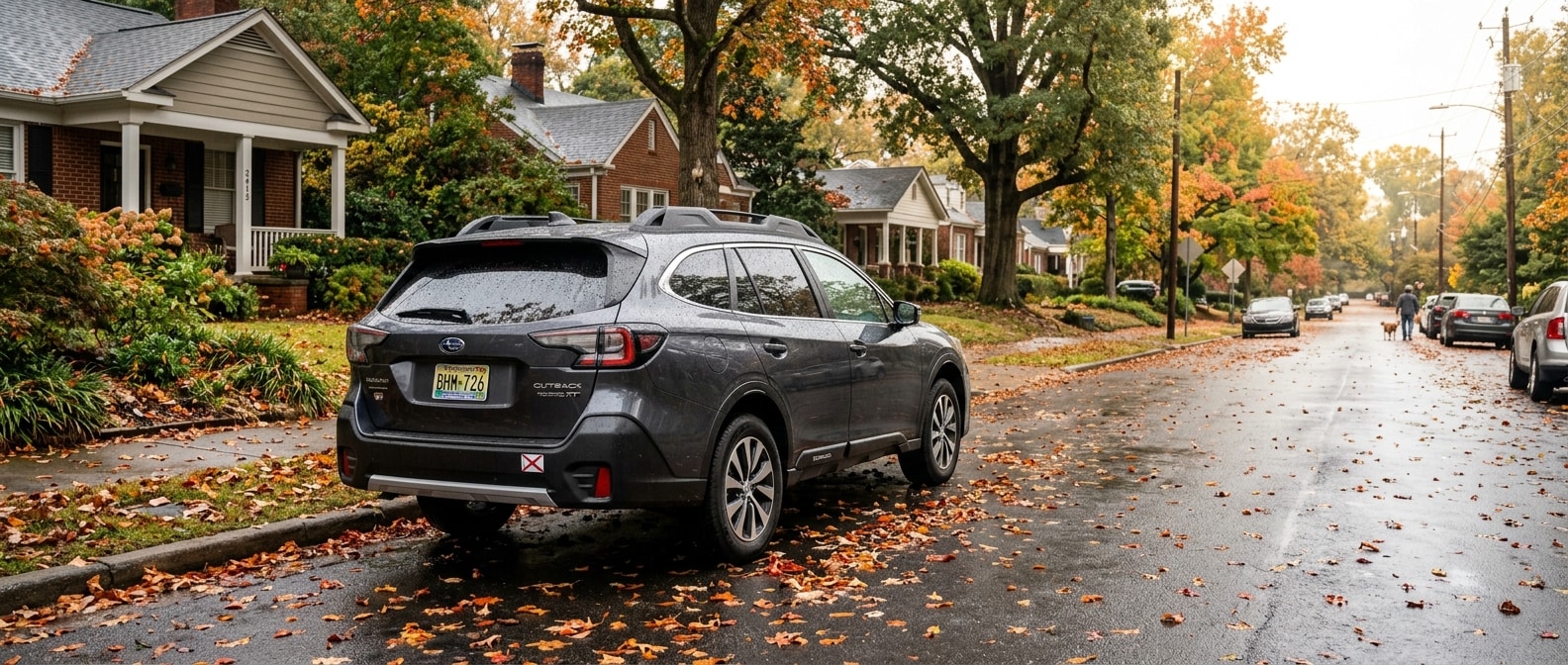
People come into our store at Hallmark Subaru Birmingham having done their homework. They know the trim they want, and they've read the comparison reviews. What they don't always have is a clear picture of what happens after they drive off Grants Mill Road. Namely, how the three mechanical things that make a Subaru a Subaru, the boxer engine, the CVT, and the symmetrical AWD system, each show up as real line items in a real budget.
We wrote this to skip the vague reassurances. You'll get the actual concept behind each cost driver, what it means for you, and why Birmingham's climate makes some of these numbers land differently than the national average suggests.
Subaru's annual maintenance cost runs slightly below the industry average, but only if you understand the three service items unique to its drivetrain that most generic maintenance guides leave out.
Browse the 2026 Subaru Outback on our lot to see current trims while you read.
How Does the Subaru Drivetrain Actually Work (and What Does It Cost)?
Subaru builds nearly its entire lineup around three interlocking pieces of engineering that don't exist in a conventional crossover, a horizontally opposed boxer engine, a Lineartronic CVT, and a Symmetrical All-Wheel Drive system that runs all four wheels full-time. Each one earns its keep on the road, and each one carries a service profile that generic maintenance checklists tend to miss. Understanding what each one does mechanically is your first step to budgeting well, so read the table before you go further.
| Drivetrain Component | How It Works | What Makes It Different | Budget Implication |
|---|---|---|---|
| Boxer Engine | Cylinders lie flat, horizontally opposed, low in the chassis | Engine must be "tilted" to access spark plugs; flat design lowers center of gravity | Spark plug replacement is more labor-intensive than a conventional engine. Subaru recommends every 60,000 miles. |
| Lineartronic CVT | Belt-and-pulley transmission with no fixed gear steps | Uses Subaru-specific fluid; the factory schedule inspects (not replaces) CVT fluid at 30,000 miles | Fluid degradation accelerates in stop-and-go heat; many experienced owners service at 25,000-30,000 mile intervals |
| Symmetrical AWD (Active Torque Split) | Engine sits longitudinally on the centerline; power flows directly front and rear without redirection | Full-time AWD (not on-demand); components are mirrored left-right for balanced torque delivery | Differential fluid changes are more frequent than on a front-wheel-drive vehicle |
The "symmetrical" label isn't marketing language. It points to a real geometry. The boxer engine's crankshaft runs front-to-back along the vehicle's centerline, the transmission sits directly behind it, and the driveshafts are equal length on each side. Most crossovers mount the engine transversely, so power has to make an angular detour to reach the rear wheels. A direct layout keeps torque delivery cleaner and the AWD engagement continuous rather than reactive.
Full-time engagement is the key phrase here, because unlike part-time or on-demand systems that send power to the rear only when the front wheels slip, Symmetrical AWD is already working at the moment your tires meet a surface.
Which Budget Items Actually Matter for Birmingham Drivers?
Birmingham runs as a heat city with occasional ice rather than a snow city, and that single distinction reshapes your Subaru budget in a way the national ownership-cost averages tend to blur, because the items that stress a Subaru drivetrain here in Jefferson County trace back to heat and stop-and-go traffic more than to road salt or deep winters. Some of those national numbers just don't map cleanly onto how we drive.
See the 2026 Subaru Forester and the 2026 Subaru Crosstrek, two models where this budget conversation plays out most directly for buyers choosing between entry and mid-range.
Fuel. The EPA rates the 2026 Forester and 2026 Crosstrek identically on their standard 2.5-liter engines, 26 city and 33 highway MPG, 29 combined. The 2026 Outback on the same 2.5-liter comes in at 25 city, 31 highway, 27 combined. The trade-off is worth naming plainly. Symmetrical AWD costs something in fuel efficiency next to front-wheel-drive competitors, and that penalty is real. Whether it's worth paying comes down to how you drive.
The CVT fluid question. The CVT fluid is the one that catches buyers off guard. Subaru's U.S. maintenance schedule lists it as a "lifetime fluid" under normal conditions (meaning inspect it at 30,000 miles, but no mandatory replacement interval is published). The counterpoint, and we hear it from owners who watch their CVT carefully, is that stop-and-go commuting in heat accelerates fluid degradation. Birmingham summers run long and humid. If your daily drive involves the kind of I-20 stop-and-go that's routine for anyone coming in from the eastern suburbs, a proactive CVT fluid service in the 25,000-to-30,000 mile range is a conversation worth having with our service team. Subaru doesn't demand it. We suggest it as cheap insurance against far pricier transmission work.
Differential fluid. Because Symmetrical AWD runs all four wheels continuously, the front and rear differentials see more regular use than those on a front-wheel-drive vehicle. Subaru recommends more frequent differential fluid changes to match, so budget for it early. It's an inexpensive service, and a quick-lube shop won't flag it, so planning ahead lands on you.
Spark plugs. Plan for spark plugs every 60,000 miles, per Subaru's schedule. The boxer engine's horizontally opposed layout puts the plugs against the sides of the engine bay, which means the engine has to be tilted for access. Expect more labor than a conventional plug job, and set the money aside ahead of time.
The good news on depreciation. The 2026 Forester is projected to depreciate over five years at a rate among the lower figures in its class. The Outback sits in the top 10 percent of mid-size SUVs for five-year cost-to-own. A vehicle that holds its value well costs you less when you trade or sell, which offsets the higher service line items above.
Ownership Cost Terms You'll Actually Need
| Term | What It Means in Plain Language |
|---|---|
| Lineartronic CVT | Subaru's continuously variable transmission; uses a steel belt and pulley system instead of fixed gears. Requires brand-specific fluid. |
| Active Torque Split AWD | The version of Symmetrical AWD on CVT models (Forester, Outback, Crosstrek); splits torque roughly 60/40 front-to-rear and adjusts continuously without driver input. |
| Boxer Engine | Subaru's horizontally opposed four-cylinder, where cylinder pairs face each other across the crankshaft. Sits lower in the chassis than an inline or V engine. |
| Differential Fluid | The lubricant inside the front and rear axle differentials. Subaru's AWD architecture means both differentials are always engaged, so fluid maintenance matters more than on a two-wheel-drive vehicle. |
Schedule a Subaru Service Appointment
What This Means for Your Next Vehicle Decision
Subaru's average annual maintenance cost runs slightly below the industry average, and that headline holds up as long as you know where the money actually goes, which is into the boxer, the CVT, and the differentials. Budget for those three items specifically and ownership stays genuinely predictable; ignore them and an unpredictable bill eventually finds you.
For Birmingham buyers, the AWD case is real and concrete. The city gets two or three ice events a year where roads along I-20 and the surrounding overpasses become treacherous, precisely because the metro isn't equipped to treat them the way a northern city would be. Symmetrical AWD doesn't replace careful driving or proper tires. It never does. What it does do is send power to all four wheels before you feel a problem. Understand the mechanism, then weigh it for yourself. In a city where one ice event can shut things down for a day, the value of already-engaged AWD is something each buyer has to weigh into the decision.
Weigh it in three parts. The fuel economy trade-off is real, the service complexity is real, and the depreciation advantage is real too. An honest picture, plain and simple.
Talk to our financing team about structuring a purchase that works for your budget.
Frequently Asked Questions
Does Subaru AWD cost more to maintain than a regular crossover?
Yes, modestly. Symmetrical AWD runs all four wheels continuously, so you'll have front and rear differential fluid to maintain on a more regular basis than a front-wheel-drive vehicle. The bigger cost variable unique to Subaru is the CVT fluid. The factory schedule lists it as a lifetime fluid under normal conditions, though many experienced owners and independent technicians recommend proactive servicing around 25,000-30,000 miles under demanding stop-and-go conditions. Add the boxer engine's spark plug replacement every 60,000 miles, which takes more labor than a conventional engine layout. Taken together, these items are predictable and budgetable, and they're not emergencies once you plan for them.
Is Subaru reliable enough to own long-term in Birmingham's heat?
Subaru's overall maintenance costs run just under the industry average, and models like the Outback and Forester are built with long ownership in mind. Many stay on the road well past 150,000 miles. The heat factor matters most for the CVT fluid, since long Alabama summers with stop-and-go commuting put more thermal stress on transmission fluid than mild-climate driving does. A proactive fluid maintenance approach, worked out with our service team around your specific driving patterns, is the practical answer to keeping reliability high in Birmingham's climate.
Categories:
Social