
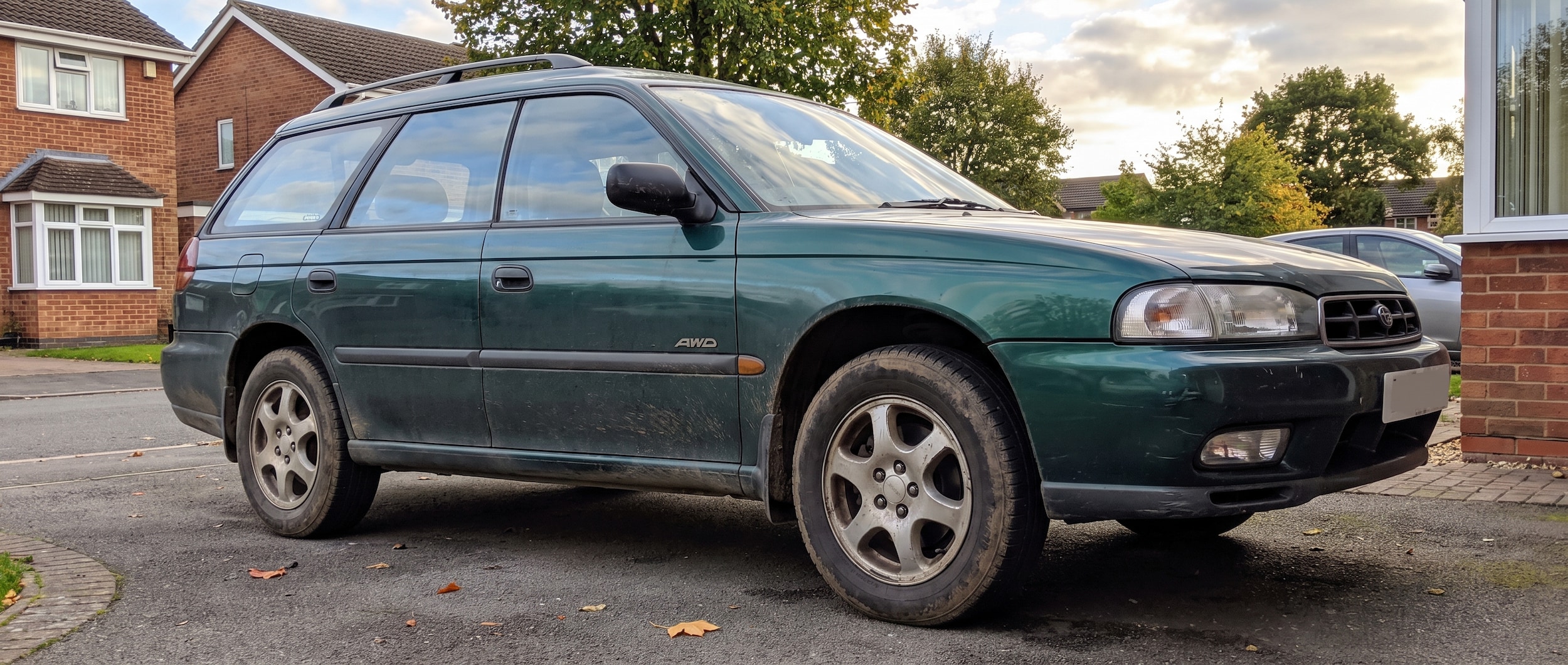
The plan is simple. You've found a used Subaru Outback (or a Forester, or a Crosstrek) somewhere in the Birmingham metro, and now you want to know whether it's actually worth buying. Most used-Subaru checklists online hand you the same five items a generic shop would give anyone shopping a used Toyota, things like check the mileage, look for rust, ask for service records. Call that a starting point rather than a strategy.
Subarus carry two mechanical quirks that most non-Subaru shops don't flag and most sellers don't volunteer. One is a Continuously Variable Transmission (CVT) whose reliability story ties strongly to model year. The other is a Symmetrical All-Wheel Drive system with a tire-tolerance rule that quietly stresses the drivetrain from the day you drive home if you break it. We see the downstream results of both on our service drive. The guide front-loads that knowledge so you show up informed.
The day has three stops. One to look at the car. One to verify the paperwork and history. One with us.
Browse our current pre-owned Subaru inventory if you'd like a head start before the visits below.
What's the Route? A Three-Stop Inspection Day
| Stop | Estimated time | What happens here | What to bring |
|---|---|---|---|
| Stop 1: The car itself | 60 to 90 min | Visual, mechanical, and AWD tire inspection at the seller's location | Flashlight, tire-tread depth gauge, phone for photos |
| Stop 2: VIN history and CVT check | 30 to 45 min | Pull the vehicle history report, decode the model year, confirm CVT condition | VIN from the seller, laptop or phone |
| Stop 3: Our service bay | 45 to 60 min | Pre-purchase inspection by a Subaru-trained technician | The car (drive it here or have it towed if mechanicals are questionable) |
Block off a full morning or a solid Saturday afternoon. It's worth every minute.
The Stops: What to Actually Do at Each One
Stop 1: At the Car (the Subaru-Specific Walk-Around)
Start your walk-around at the tires, before anything else under the hood. On a Symmetrical AWD Subaru, mismatched tires do something that catches buyers off guard.
How much variance is too much? Subaru's own guidance specifies that all four tires should not differ by more than a quarter-inch in circumference, which corresponds to roughly 2/32 of an inch in tread depth, so that's your ceiling. When circumferences vary beyond that tolerance, the center differential has to compensate continuously instead of only when you corner or slip. That sustained load accelerates wear inside the differential clutch packs. It won't announce itself loudly. It just shortens the life of expensive parts.
Use a tread depth gauge. Measure all four corners. If the variance is significant and the seller doesn't know the tire history, factor in the cost of a full set of four (not two, four).
Under the hood: boxer engine basics. Subaru's horizontally opposed engine is well-engineered. It also explains why head gasket history matters on older models. Head gasket problems were most common on pre-2011 naturally aspirated 2.5-liter engines. A well-maintained car from that era may already have had a gasket replacement done with OEM parts, which is documented history and nothing to fear. What you're watching for is coolant with a milky or frothy appearance (mixing with oil), any oily residue around the cylinder heads, or a sweet smell from the cooling system. On a 2012 or newer car, this concern drops sharply. Look for it anyway on anything older.
See available Subaru Forester listings if the Forester is your target model. It shares the same drivetrain logic.
EyeSight: the windshield question. Any used Subaru equipped with EyeSight (the dual-camera driver assist system) needs one specific question. Has the windshield ever been replaced? Subaru specifies that EyeSight camera recalibration is required after any windshield replacement, and it requires factory-level diagnostic equipment. A generic glass shop that replaced the windshield without performing the calibration may have left EyeSight partially or fully non-functional. On a test drive, check whether EyeSight is actively operating (the dashboard indicator confirms it). A persistent warning light or a disabled system after what looks like routine glass work is a sign the calibration step was skipped.
Stop 2: The VIN Check and CVT Model-Year Decode
Stop 2 is where a good used-Subaru deal separates from an expensive one. Pull the vehicle history report and look at two things together, the model year and the transmission type.
Subaru's Lineartronic CVT had documented reliability issues in vehicles produced between 2010 and roughly 2017. The problems were real enough that owners reported shuddering at low speed, hesitation when accelerating, and a whining noise that wasn't present earlier. Starting with the 2018 model year, Subaru made meaningful engineering revisions to the Lineartronic: better cooling, revised clutch packs, and updated software. Reliability improved substantially.
The practical split works like this. A 2017 or older CVT-equipped Subaru needs its transmission history scrutinized carefully (fluid service records, any related repair history). A 2018 or newer model is a meaningfully different proposition, cleaner history and all. Neither generation is maintenance-free. Subaru-spec CVT fluid can't be swapped for generic fluid, and fluid condition matters.
View Subaru Crosstrek listings. The Crosstrek shares this CVT history starting with the 2013 model year.
Timing belt or timing chain? Subaru moved to timing chains on newer engines, which don't have a fixed replacement interval the way belts do. On older belt-equipped engines (generally pre-2013 depending on model), confirm that the belt was replaced on schedule. A missed timing belt interval on a Subaru boxer engine is not a minor oversight.
One more VIN lookup: NHTSA. Search the VIN at the NHTSA website before you leave Stop 2. It takes three minutes and shows any open recalls. A recall isn't a disqualifier (most can be remedied at no cost at a Subaru dealer), but you'll want to know about it up front, well before you sign.
Stop 3: Our Service Bay (the Pre-Purchase Inspection)
Drive it to us or, if something felt off on the test drive, arrange to have it transported. Our technicians are Subaru-trained and will put the car on a lift, run a scan tool for stored fault codes (including any CVT or EyeSight codes that haven't triggered a warning light yet), and walk through the drivetrain systematically. We can check differential fluid condition, inspect CV boots and axles, and verify whether EyeSight is calibrated correctly.
A pre-purchase inspection is the one stop that removes guesswork from everything you did at Stops 1 and 2.
Schedule a Pre-Purchase Inspection
Print-and-Go Checklist
Take this list with you to Stop 1, and work it top to bottom. Check each item before you move to the next one.
- [ ] Measure tread depth on all four tires (confirm variance is within 2/32 of an inch across all four corners)
- [ ] Confirm all four tires are the same brand and size
- [ ] Check coolant reservoir (fluid should be clear or lightly tinted, not milky or frothy)
- [ ] Look for oil residue or weeping around cylinder head area
- [ ] Smell near the radiator cap area (a sweet smell can indicate coolant mixing)
- [ ] Confirm EyeSight indicator is active and not displaying a persistent warning
- [ ] Ask whether the windshield has been replaced, and whether EyeSight was recalibrated afterward
- [ ] Check CV boots at all four corners for cracking or torn rubber
- [ ] Look under the car for fluid spots (transmission fluid is reddish; coolant is often green or orange)
- [ ] Request service records and look for CVT fluid change history
- [ ] Pull the VIN history report before agreeing on anything
- [ ] Look up the VIN on the NHTSA website for open recalls
- [ ] Schedule a Subaru-trained pre-purchase inspection before finalizing
Tweak It to Your Crew
The checklist above covers every used Subaru, and here's how to weight the priorities depending on which model you're shopping.
If it's an Outback or Legacy (2010 to 2017): The CVT history and the tire match are your two biggest flags. These are the models where the Lineartronic's early-generation issues were most concentrated. Get the transmission fluid history. Budget for a full four-tire set if tread depth is uneven.
If it's a Forester or Crosstrek (2014 to 2017 CVT): Same CVT caution, slightly later introduction date. Foresters also have a documented history of wheel bearing and CV joint wear at higher mileage. Listen for a low hum or a grinding tone that changes pitch with vehicle speed in a long sweeping curve on I-459 or I-20. That sound pattern points toward a wheel bearing.
If it's a 2018 or newer model of any kind: The CVT concern is substantially reduced. Shift your attention to EyeSight history (windshield replaced? calibration documented?), tire match, and whether the car has any open recalls. These cars are straightforwardly good used buys when service records are clean.
If you're buying as a first Subaru: The AWD tire rule is the one thing we'd most want you to know before you walk into any used-car conversation. The rule feels counterintuitive (replacing one tire seems like a reasonable shortcut), and it's the detail that non-Subaru shops routinely miss. Now you know it.
Birmingham's afternoon thunderstorms and the occasional ice event that shuts the metro down every couple of winters are exactly the conditions where Symmetrical AWD earns its keep. It's worth protecting with a drivetrain that's been properly inspected.
Categories:
Social