

Start with question one: what's the money factor? That single ask separates a prepared lessee from someone who signs whatever lands on the desk. We've walked a lot of people through their first Subaru lease at Hallmark Subaru Birmingham, and the pattern we see isn't that people get tricked. It's that they don't know which numbers are fixed and which ones they can actually influence.
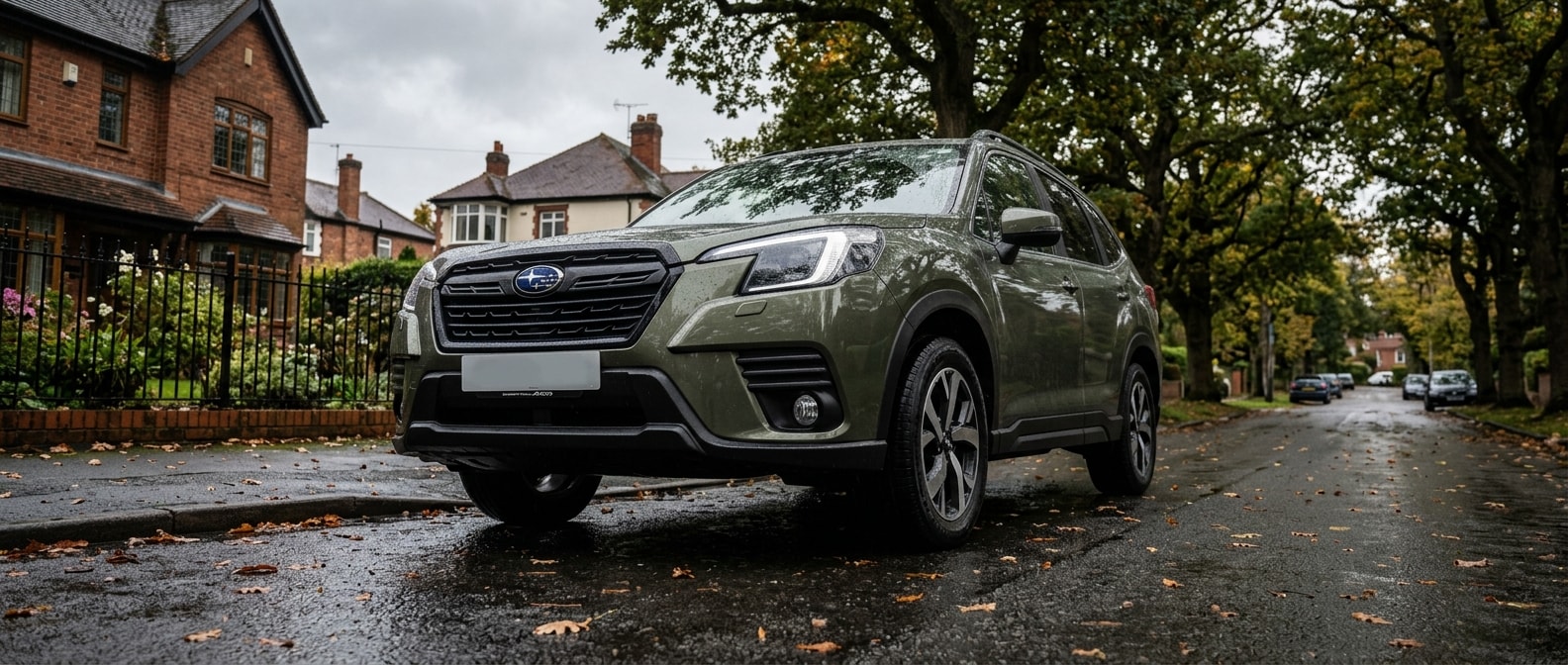
Ask these seven questions before you sign anything. The 2026 Subaru Forester is our top overall pick for first-time lessees because its residual value and lease structure give you more room to work with than most vehicles in the segment. We'll explain why below.
The Ranking at a Glance
| Rank | Model | Best For | Standout Lease Spec |
|---|---|---|---|
| 1 | Forester | First-time lessees, families | Strong residual value; EyeSight standard on every trim |
| 2 | Crosstrek | Commuters, compact footprint | Entry-level monthly lease cost in the lineup |
| 3 | Outback | Road-trippers, cargo haulers | Redesigned 2026 body gives a fresh tech baseline |
| 4 | Ascent | Three-row families | Higher lease investment; best when space is non-negotiable |
Question 1: What Is the Money Factor, and Is It the Buy Rate?
This is the lease equivalent of an interest rate, expressed as a small decimal. To convert it to something readable, multiply by 2,400. That's the number you want to evaluate. Here's the part most guides skip: Subaru Motors Finance sets a base rate (the "buy rate"), but dealers can mark it up. Ask specifically whether the rate being quoted is the buy rate from Subaru Motors Finance or an adjusted figure. A legitimate answer is a specific number, not a range or a redirect to the monthly cost.
Subaru consistently ranks above average for residual values among Japanese brands. That matters because when the residual is higher, the finance charge component of the payment becomes a bigger share of the total. A half-point of money-factor markup carries more real cost than people expect on a vehicle holding its value well.
Question 2: What Is the Residual Value, and What Percentage Is That?
The residual is the predicted value of the vehicle at lease-end, set by Subaru Motors Finance as a percentage of the vehicle's sticker price. You cannot negotiate it. What you can do is understand it. A higher residual means a lower monthly cost because you're financing less depreciation.
Ask for the percentage, not just a dollar figure. That lets you compare apples to apples across trims and models. The Crosstrek is among the most accessibly priced models in the Subaru lineup, which means its residual percentage is doing real work for the payment. The Forester's tends to be one of the stronger ones in the compact SUV segment, which is part of why it leads our list.
Question 3: How Many Miles Are You Estimating, and What's the Per-Mile Overage Fee?
Standard Subaru lease offers come in tiers: typically 10,000, 12,000, or 15,000 miles per year. The overage charge when you exceed the cap is real and adds up fast at turn-in. One published Subaru lease disclosure lists the per-mile overage at a modest rate per mile over the contracted allowance.
Think about Birmingham specifically. The US-280 corridor from Mountain Brook through Irondale to Grants Mill Road isn't a short hop. If you're combining a daily commute on I-20 or I-459 with weekend trips toward the foothills northeast of the metro, 12,000 miles a year may be tighter than it looks in September. Use your last year's odometer readings, not your best-case estimate. Buying miles upfront at signing is almost always cheaper than paying the overage rate at turn-in.
Question 4: What Goes Into the Capitalized Cost, and What Can I Reduce?
The capitalized cost is the agreed vehicle price the lease math starts from. It functions like the selling price in a purchase. Unlike the residual and money factor, this number is negotiable. Ask for it line by line: the vehicle price, the acquisition fee (which Subaru Motors Finance charges and which is typically folded in), any added accessories or protection packages, and any dealer fees.
A common misunderstanding we hear: putting a large amount of cash down at signing feels like it lowers the deal, but on a lease it only reduces the monthly cost. It doesn't change the residual, the money factor, or the buyout amount at the end. If the vehicle is totaled or stolen, you likely don't recover that cash. Up-front payment on a lease is a different calculation than up-front payment on a purchase.
See Current Subaru Lease Offers
Question 5: What Does "Excessive Wear and Tear" Actually Mean in Writing?
Lease-end charges for condition are one of the most consistently surprising costs for returning lessees. "Normal wear and tear" sounds clear until you're standing next to your Outback three years later with a scuffed bumper and a small ding. Ask to see the written definition before you sign.
Subaru Motor Finance uses a specific standard. Scratches and dents within a defined size threshold are typically acceptable. Tires must meet a minimum tread depth. Cracked windshields, missing trim pieces, and interior stains above a certain size are not. Know the standard before you drive the car, not the month you're returning it. The 2026 Subaru Outback in particular tends to attract buyers who load it up for weekend use. That's exactly the use case where knowing the wear standard upfront pays off.
Before turn-in: do a walkthrough of the written wear-and-tear standard at least 90 days before your lease ends, while you still have time to address anything that would exceed the threshold.
Question 6: What Happens If You Need to Exit Early?
Life changes. Early termination on a lease is possible, but it carries a cost. The amount owed is generally the sum of remaining payments plus an early-termination fee, less the vehicle's current wholesale value. On a relatively new lease, that can be a significant figure.
Ask two things: what is the exact early-termination calculation method, and is there a transfer option? Some leases allow you to transfer the remaining term to another qualified driver. It's not universally available, but it's worth confirming before you need it. A short list of the realistic exit paths at any point in your lease:
- Pay the remaining balance and an early-termination fee
- Transfer the lease to a qualified third party (if the lease program permits)
- Trade the vehicle, with the dealer paying off the remaining lease obligation
Question 7: What Are Your Lease-End Options, and Is the Buyout Price Set Now?
At the end of a standard closed-end lease, you have three choices: return the vehicle, purchase it at the residual value set at signing, or (if available) roll into a new lease. The buyout price is fixed in the contract today, regardless of what the used-car market does over three years.
That matters in both directions. If the vehicle's actual market value at lease-end exceeds the residual, buying it out can be a genuine value. If the market has softened, you return it without exposure. The Ascent is a good example: three-row family SUVs with standard all-wheel drive tend to hold value well in the Southeast, where they're in consistent demand year-round.
Ask your finance team to walk you through all three end-of-lease paths on paper. And know this ahead of time: Alabama taxes leases differently from most states. Per the Alabama Department of Revenue, the state imposes a rental tax on gross lease proceeds (not a standard sales tax on the vehicle price), and it applies to your up-front payment and cap cost reductions as well as monthly costs. Local taxes in Jefferson County may layer on top of the state rate. That's a line item worth asking about explicitly so it doesn't appear as a surprise on your first statement.
Why the Forester Is the Right Starting Point for Most Birmingham Lessees
Not because it's always cheaper. It's not. The Crosstrek typically carries the lower entry payment in the Subaru lineup. But for someone leasing a Subaru for the first time, the Forester hits the balance that matters: the standard EyeSight Driver Assist system on every 2026 trim means the safety technology doesn't vary by what you can afford, the ground clearance (8.7 inches on standard trims) holds up for the occasional unpaved road or high-water underpass after a Birmingham afternoon thunderstorm, and the residual value tends to be one of the stronger ones in the compact SUV class.
The honest tradeoff: if you're a solo commuter or primarily driving urban Birmingham errands, the Forester is more car than you need and the Crosstrek does the same job more efficiently. The Forester is the right answer when you actually use the cargo space and want the technology to stay current through the full three years.
Come talk to our team on Grants Mill Road. We'll pull the current money factor, lay out the end-of-lease options, and make sure the mileage cap fits how you actually drive.
Categorías:
Social