
By the Hallmark Subaru Birmingham Team | September 2026
The decision is not really new against used. It is how much you want verified for you before you sign. A new Subaru has no history to verify. A Certified Pre-Owned Subaru has a history, and Subaru puts it through an eligibility gate and a 152-point inspection before it is allowed to carry the badge. Everything else follows from that one difference.
The short version
- Certified Pre-Owned is not a label a dealership applies. Subaru sets the rules, and a car that fails any of them cannot be certified.
- The gate: current or past five model years, under 80,000 miles, no major accident history, and no non-manufacturer modifications.
- Then a 152-point inspection by factory-trained technicians. Anything that does not pass is repaired, reconditioned or replaced before certification.
- Every certified car comes with a complete CARFAX report, so the history is disclosed rather than discovered later.
- New makes sense when you want a specific configuration or the newest technology. Certified makes sense when you want a known car with the checking already done.
The Outback is where this comes up most in our showroom, because it is the model people cross-shop across both paths, and the trims overlap enough that the real question stops being the car and becomes the process.
What is the real difference between the two?
One is about specification. The other is about verification.
| New | Certified Pre-Owned | |
|---|---|---|
| How it is configured | You choose the trim, color and options | You choose from what exists on the lot |
| History | None to check | Disclosed in a complete CARFAX report |
| Eligibility gate | Not applicable | Current or past five model years, under 80,000 miles, no major accident history |
| Modifications | Factory as built | Non-manufacturer accessories make a car ineligible |
| Inspection before sale | Standard pre-delivery preparation | 152 points, by factory-trained technicians |
| What fails inspection | Not applicable | Repaired, reconditioned or replaced before certification |
| Technology | The current generation | The generation of that model year |
That eligibility list is worth reading twice, because most people assume Certified means "used, but the dealership checked it." It does not. Only Subaru vehicles can be certified, and a car that has been modified with non-manufacturer parts is out of the program no matter how good it looks.
The single deciding factor is not price or age. It is whether you want to choose the exact configuration, or whether you would rather have someone else do the verification on a car that already exists.
What does the 152-point inspection actually cover?
Enough that "inspected" stops being a vague word.
The checklist runs across the engine compartment, the electrical system, the drivetrain, and the interior and exterior condition. Inside that: fluid levels and filters, the battery, tires and tire pressure, brakes, the exhaust system, the audio and power equipment, air conditioning and heater function, the defogger, transmission operation, cruise control and the moonroof. Factory-trained technicians run it as a full review of the vehicle.
The part that matters more than the number is the rule attached to it. Every item that does not pass must be corrected before the car can be certified. A certified Subaru is not a car that passed with a few notes. It is a car where the notes were fixed.
For a Forester or a Crosstrek coming out of a few Alabama summers, that matters in specific places: battery condition after heat, brake wear from stop-and-go on US-280, and air conditioning performance, which is the system nobody tests properly on a test drive in September.
Where new genuinely wins
Two situations, said plainly.
- You want a configuration that does not exist used. A specific trim, a specific color, a particular option group. Certified inventory is whatever came back to the lot, and waiting for the exact combination can take months.
- You want the newest driver-assistance generation. EyeSight and the surrounding technology have moved meaningfully across recent generations. If you want the current version, the current model year is the only place to get it.
Neither of those is about the car being "better". They are about control over the specification, which is a real thing to want and a real reason to buy new.
So which should you pick?
By buyer, not by budget.
- Pick new if you have a specific configuration in mind, if you plan to keep the car long enough that the current technology generation matters, or if you simply do not want to evaluate a history at all.
- Pick Certified Pre-Owned if you would rather have the verification done than do it yourself. The eligibility gate removes the cars with real problems before you ever see them, the inspection catches what a test drive cannot, and the CARFAX report means the history is handed to you rather than found afterwards.
- Pick either with confidence on an all-wheel-drive Subaru if what you actually care about is how the car behaves on a wet on-ramp in a Birmingham thunderstorm. Symmetrical all-wheel drive is standard equipment across the lineup, new or certified, and it does not degrade with the model year.
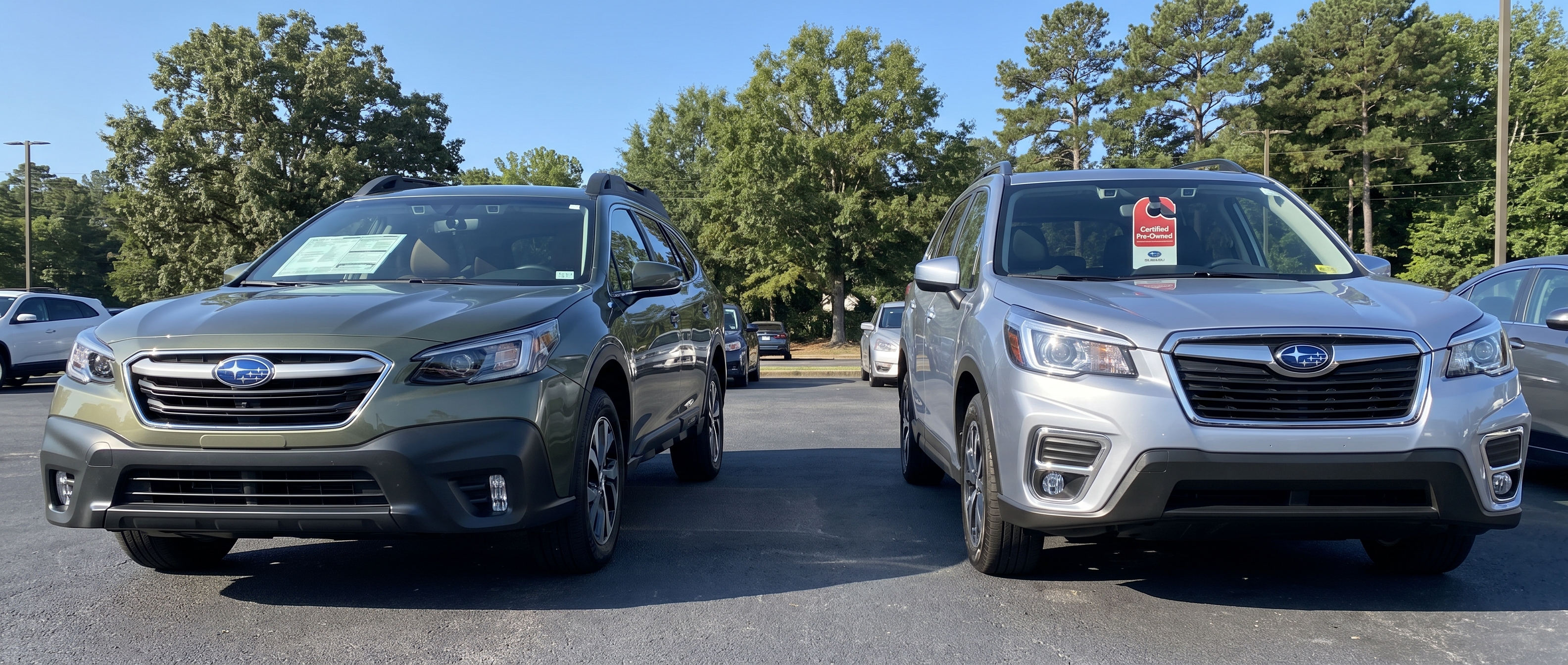
Come see both on the same visit. Drive a new one and a certified one back to back on the roads you actually use, and the answer usually becomes obvious in about twenty minutes. Everything on the ground sits on our pre-owned inventory page if you want to look first.
Common questions about buying certified in Birmingham
What makes a Subaru eligible for Certified Pre-Owned?
Four things, and all of them have to be true. The vehicle has to be from the current or past five model years, it has to show fewer than 80,000 miles, it cannot have major accident history, and it cannot carry non-manufacturer accessories or modifications. Subaru also certifies only Subaru vehicles, so another make traded in here can never enter the program. A car that fails any one of those is sold as a regular pre-owned vehicle instead, which is a perfectly good thing to buy, just without the certification behind it.
Is a certified Subaru inspected more thoroughly than a regular used car?
Yes, and the difference is in the rule rather than the number. Certification requires a 152-point inspection by factory-trained technicians covering the engine compartment, electrical system, drivetrain, and interior and exterior condition, and every item that does not pass has to be repaired, reconditioned or replaced before the car can be certified. A regular pre-owned vehicle receives a standard inspection and is sold as it is, with anything found disclosed rather than necessarily corrected.
Categories:
Social