

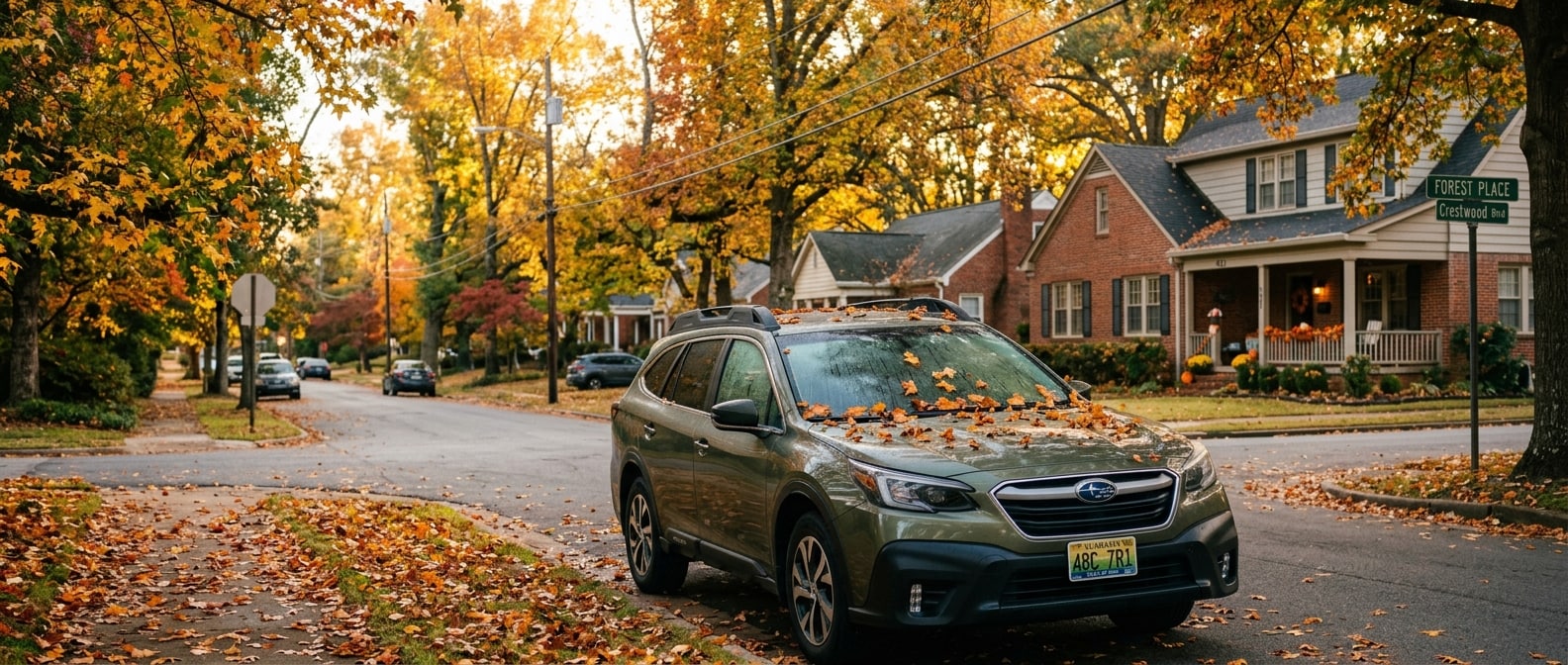
Between the first leaves dropping and the chemistry on your hood getting ahead of you, there's a real window, and it's shorter than you'd expect. Tannic acid from decomposing leaves can begin etching automotive clear coat in as little as 24 to 48 hours, and our area's sweetgum and water oak trees are among the highest-tannin species in central Alabama. If your Subaru lives under a canopy on any of the eastern suburban corridors, that clock starts the moment a wet leaf lands.
- Birmingham's 2026 fall leaf-drop window runs roughly October 19 through early November (per the 2026 Farmers' Almanac projection for Alabama), which is your highest-risk period for paint damage.
- Tannic acid from decomposing leaves begins etching clear coat within 24 to 48 hours, especially when moisture is present.
- Tree sap contains resins and organic acids that cross-link and bond to clear coat under UV heat, making fresh removal far easier than hardened removal.
- Older Subaru generations (pre-2020) carry a well-documented softer clear coat that Subaru forum owners have flagged for years. Act faster, wax more often.
- The single best habit: hand-remove leaves individually (never brush or blow), then wash within 24 hours.
A fair question before the season turns is whether leaves will hurt your paint, and yes, they will. What's worth sorting out is how quickly, how seriously, and what it depends on for your specific vehicle. The generation of your Subaru changes the calculus, which is why we're breaking this down by model year range instead of handing you a generic checklist.
Browse our pre-owned Subaru inventory
Which Subaru model years are the sweet spot for paint durability?
Subaru refreshed its clear coat formulation across the lineup starting with the 2020 model year, which aligns with a broadly documented improvement in paint hardness that owners and detailers have tracked since then. None of that makes a 2020-or-newer vehicle immune to leaf or sap damage. What it buys you is a somewhat longer window for DIY recovery before you're looking at professional correction.
| Generation / Year Range | Clear Coat Profile | Sweet Spot? | Leaf/Sap Risk Level | What We See on the Lot |
|---|---|---|---|---|
| 2015-2019 (Gen 4 Outback / Forester / Crosstrek) | Softer factory clear coat (documented in owner forums) | With consistent care, yes | Higher. Acts faster | Rock chips common; sap stains need quick attention |
| 2020-2022 (Post-refresh, pre-current gen) | Improved clear coat hardness vs. prior gen | Yes, sweet spot | Moderate | More forgiving, but no substitute for timely leaf removal |
| 2023-2026 (Current-gen Outback, Forester, Crosstrek, Ascent) | Current factory spec; benefits from latest formulation | Yes, best available | Moderate. UV still accelerates sap cure | Newer, so paint history shorter; still needs fall prep |
| WRX / BRZ (all years) | Enthusiast tier, typical for segment | Strong across model years | Moderate | Flat hood and roof make leaf pooling easy to spot and clear |
Here's the straight take. No generation is safe to ignore. Whether you're looking at a 2017 Forester or a 2025 Forester, leaves can etch the clear coat either way. What changes is how fast the process starts and how much DIY margin you have before professional polish becomes necessary.
Which model years should you watch most carefully?
The 2015-2019 generation is the one our service team watches closest when owners bring vehicles in after a fall, and the reason runs two ways. Subaru's "soft paint" reputation predates that window (WRX and STi owners have tracked it since at least the early 2010s), and the Gen 4 Outback, Forester, and Crosstrek generation is where much of the Birmingham pre-owned market sits right now. Those vehicles carry a softer clear coat relative to later generations, and their age means whatever factory paint protection they left with has long since worn down through normal washing and UV exposure.
There are no NHTSA recalls specifically for Subaru paint quality on these generations, and none for leaf or environmental paint damage on any generation (that's not how recalls work). What we do have is a well-documented pattern in owner forums, where Subaru's factory clear coat chips and scratches more readily than some competitors in the same segment. So diligent fall care earns its keep on these cars.
Two things are worth watching on these older vehicles.
- Horizontal panels. Hood, roof, and trunk lid are where leaves pool and hold moisture against the finish. A flat 2016 Outback hood can hold a pile of wet sweetgum leaves for 36 to 48 hours during an overnight rain cycle and not drain.
- Drain channels and seams. Decomposing leaves pack into windshield cowl seams and under wiper arms. This doesn't damage paint directly, but when they stay wet against body seams, they can promote corrosion over a longer Alabama fall.
See current Forester inventory
Pros and cons of the two main removal approaches
Before we get to the by-buyer section, the choice usually comes down to handling leaf and sap damage yourself or bringing the car in, and both have a real place depending on how fresh the contamination is. Here's a straight comparison.
| Approach | Pros | Cons |
|---|---|---|
| DIY (hand removal, diluted isopropyl alcohol, wax) | Fast, low cost, effective on fresh damage (within 24-48 hours) | Requires correct dilution (10-25% isopropyl in distilled water); strips any existing wax protection; ineffective on hardened sap |
| Professional detailing / paint correction | Reaches bonded and hardened sap; handles any etching damage; restores full protection layer | Costs more; takes time; some etching is permanent regardless |
| Do nothing | Requires no effort | Tannic acid etching can become permanent within days; sap can reach the color coat beneath clear coat if left for weeks; harder removal attempts risk micro-scratches |
We've seen both ends of this. A quick hand-removal plus a same-day wash handles most fresh leaf contact without any damage at all. But leave a sweetgum leaf wet on a dark-colored 2017 Outback through a week of morning dew, and it can etch a fossil-print silhouette into the clear coat. A wash won't bring that back.
Which generation is right for which owner?
For someone shopping used, or weighing how much fall care makes sense on a vehicle they already own, the model-year decision is where the rubber meets the road, and the right answer shifts with how old the clear coat is. Match your effort to your generation, and you'll spend it where it actually pays off.
If you own or are buying a 2015-2019 Subaru: Treat fall as a high-maintenance season. Hand-clear leaves every morning you park under a canopy. Fresh sap should come off the same day, using a 10-to-25 percent diluted isopropyl alcohol solution on a microfiber cloth, followed right away by a rinse and a fresh coat of carnauba wax or sealant. A professional fall detail makes real sense for this generation, especially for any vehicle parked under the sweetgum and water oak canopy common along Grants Mill Road. Grants Mill Road is in Birmingham's eastern suburbs. Bring it in before the late-October drop window, not after.
Schedule a service appointment
If you own or are buying a 2020-2022 Subaru: You've got a bit more margin here, though the same rules apply. The improved clear coat buys you a slightly longer removal window, not an unlimited one. Wax twice a year (spring and fall), hand-clear leaves, and address any sap within 24 to 48 hours. On this generation, a consistent wax schedule genuinely earns its keep.
If you own a 2023-2026 Subaru: These vehicles are newer, so the factory paint protection sits more intact, and that's an advantage worth keeping. A fall wax before the October-November leaf-drop window gives you a sacrificial layer between the tannic acid and the clear coat. The wax takes the etch that would otherwise land on the clear coat.
If you own a WRX or BRZ: Enthusiast owners already tend to be more attentive about paint. The horizontal panels on both models make it easy to spot leaf accumulation. Same timing rules apply.
The one honest downside to this whole framework is simple. Birmingham's fall is beautiful, and the eastern-suburb neighborhoods where these Subarus park are exactly the ones with the densest tree canopy. You're not going to stop parking under trees. What you can do is respond faster than the chemistry does.
Schedule a Fall Paint Inspection
Frequently Asked Questions
How long can leaves sit on my Subaru before causing permanent paint damage?
Tannic acid from decomposing leaves can begin etching automotive clear coat in as little as 24 to 48 hours, particularly when moisture from rain or morning dew accelerates the decomposition. The risk is higher on older Subaru generations with softer clear coat formulations. For vehicles from 2015 to 2019, we recommend clearing leaves the same day or the following morning at the latest. Fresh removal by hand (one leaf at a time, never with a broom or leaf blower that drags grit across the surface) followed by a wash is the baseline habit.
What's the safest way to remove hardened tree sap from Subaru paint?
The safest DIY approach is a diluted isopropyl alcohol solution, at roughly 10 to 25 percent isopropyl in distilled water, applied to a clean microfiber cloth and held gently against the sap spot for two to three minutes to soften the resin before wiping. Do not scrub. Full-strength rubbing alcohol at 70 percent or higher will strip any wax or sealant protection and can soften the clear coat with prolonged exposure. After removal, the treated spot needs a fresh protective layer (wax or sealant) applied right away. If the sap's been sitting for more than a few days in Birmingham's October sun, bring it to a professional before attempting DIY removal, because heat from even mild October afternoons bakes the resin compounds and makes them bond more aggressively to the clear coat.
Does Subaru paint require special care compared to other brands?
Subaru's factory clear coat, particularly on the 2015-2019 generation, has a well-established reputation among owners for being softer and more susceptible to rock chips and environmental contaminants than some competitors. None of that marks it as a defect, since a softer formulation is simply how this paint behaves. Subaru owners benefit more than average from a consistent wax or paint sealant schedule, especially before fall and spring. The 2020-and-newer generation shows meaningfully improved hardness. Even so, no Subaru clear coat shrugs off the tannic acid load that Birmingham's sweetgum and water oak canopy delivers in October and November.