


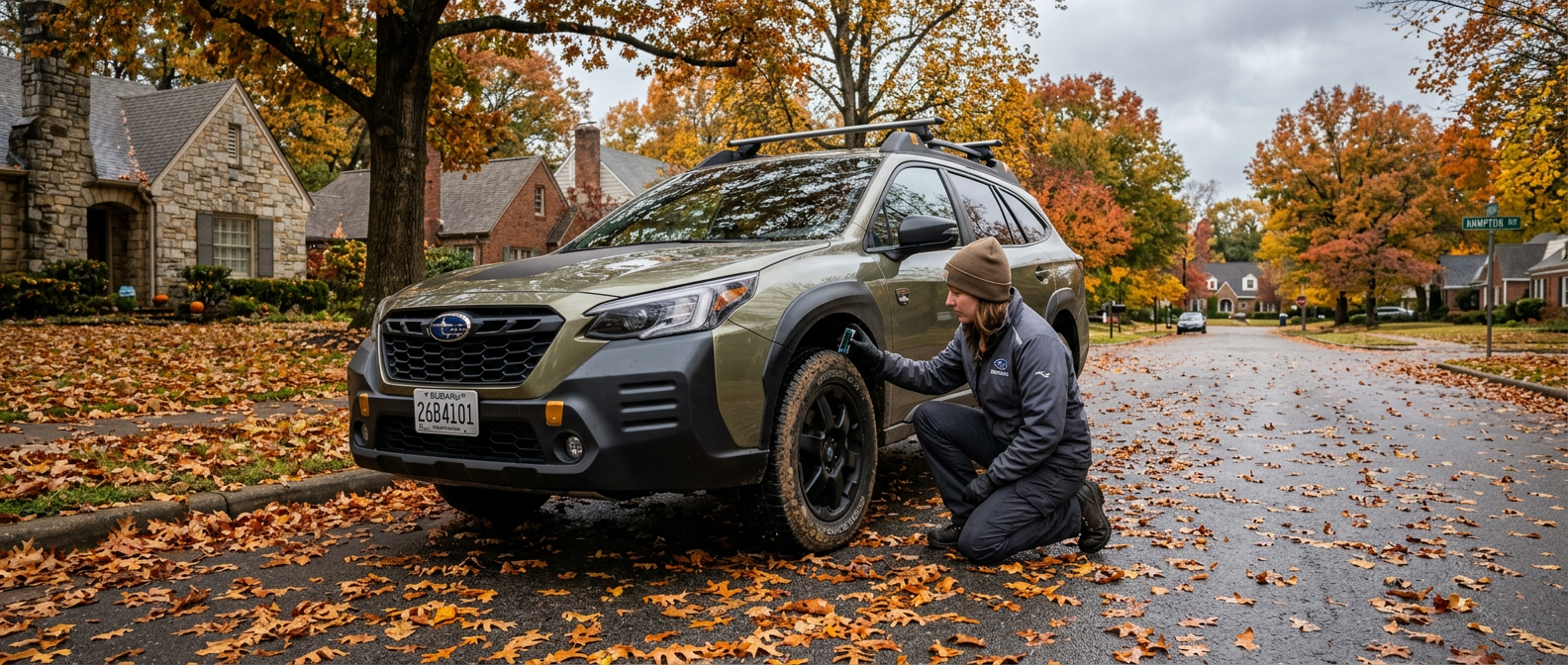
Birmingham mornings are sitting in the upper 40s right now, and afternoons climb back into the mid-70s. A 25-degree swing sounds pleasant enough. On your Subaru's tires, brake system, and EyeSight cameras, though, that swing is doing quiet, measurable work, and it catches plenty of owners off guard come November.
The short version
- Tires lose roughly 1 PSI for every 10-degree Fahrenheit temperature drop. Birmingham's daily swings this time of year can pull 2-3 PSI out before you leave the driveway.
- Subaru's symmetrical AWD system depends on all four tires wearing evenly; uneven tread doesn't just affect grip, it stresses the center differential.
- Brake fluid absorbs moisture year-round, and Alabama's long humid summer accelerates that process; Subaru specifies replacement at 30,000 miles.
- EyeSight cameras mount directly to the windshield, a chip in the camera's viewing area may require professional recalibration before the system works correctly again.
- Fall is the practical window: warm enough to work, cold weather ahead, and summer driving wear is fresh enough to catch before it compounds.
Book your fall service appointment here
How Do These Three Areas Compare for a Birmingham Subaru?
The three areas stack up differently depending on where your car is in its life, so this table won't rank them from most urgent to least. It's built to help you spot which one is most likely overdue for your specific Subaru, given what Birmingham roads and weather do to tires, brakes, and cameras over a year.
| Inspection Area | What Fall Does to It | Birmingham-Specific Factor | The Subaru Wrinkle | When to Act |
|---|---|---|---|---|
| Tires and AWD | Approximately 1 PSI lost per 10 degrees F drop; grip changes on wet leaves | Morning lows in the upper 40s after mid-70s afternoons; leaf-covered surface streets in the eastern metro | Symmetrical AWD requires all four tires within close tread depth to protect the center differential | Now, before November rains arrive |
| Brake Fluid | Moisture contamination lowers boiling point over time | Alabama's long humid summers accelerate moisture absorption into the fluid | Subaru specifies replacement at 30,000 miles; high-humidity areas may need it sooner | At or near 30,000 miles since last flush |
| EyeSight and Windshield | Fall road debris increases windshield chip risk; chips in the camera zone affect system function | Highway chip exposure on I-20 and I-459; UV-weakened wipers leave streaks that degrade camera view | EyeSight cameras mount directly to the windshield; recalibration is required after any chip repair or glass replacement in the camera area | Any time you notice a chip, a wiper streak across the camera zone, or a dash warning |
What Does Birmingham's Temperature Swing Actually Do to Your Tire Pressure?
Birmingham's temperature swing pulls real pressure out of your tires, because pressure drops roughly 1 PSI for every 10-degree Fahrenheit decrease (per AAA), and the metro is running a 25-degree spread right now, upper 40s overnight into mid-70s afternoons. So your tires could be sitting 2-3 PSI below spec on a cool morning, even if you topped them off last weekend in the afternoon heat.
Any vehicle feels this. A Subaru feels it more. The Subaru Outback and the rest of the lineup run symmetrical all-wheel drive continuously, not on demand, which makes the system more sensitive to differences in rolling circumference across all four corners than a part-time AWD setup. Subaru's own maintenance schedule calls for tire rotation every 6,000 miles on AWD models specifically to keep all four tires wearing together, so the center differential doesn't carry the load of mismatched tread depths.
A tire sitting 3 PSI low meets the road with a different-shaped contact patch. On dry pavement the difference stays subtle. Surface streets through Irondale and the eastern metro collect leaves in October and November. On those wet leaves, the difference isn't subtle at all.
When you check, remember that the spec on your driver's door jamb assumes a cold tire, meaning the car has been parked for at least three hours and driven less than a mile. Check after a commute and you'll read 4-6 PSI higher than the true cold pressure. So you'd inflate to the wrong number and never know it. Cold readings in the garage before you leave are the ones that count.
Don't lean on the TPMS light to catch a gradual low either. According to AAA, those systems don't alert until the tire is already about 25 percent below the recommended spec.
Why Alabama's Summer Makes the Brake Fluid Check More Urgent in Fall
Alabama's long summer loads your brake fluid with moisture, and fall is the moment to check it, because every model we sell uses DOT 3 brake fluid that's hygroscopic by nature and pulls water from the air continuously through the rubber lines and reservoir cap, no matter how much you drive. The Subaru Forester, the Outback, the Crosstrek, the Ascent. What changes between cars is how fast the fluid takes on water, and higher humidity means faster absorption. They all drink it in.
Birmingham just came out of one of the most sustained humid stretches of the year. A full Alabama summer of 70-plus percent humidity gives brake fluid months of ideal conditions to pull in moisture. Fresh DOT 3 has a dry boiling point around 401 degrees F. After prolonged moisture absorption, that boiling point can drop to 284 degrees F or lower. The gap between those two numbers is where brake fade lives (the hard stop at the bottom of a long grade on US-280, the sudden deceleration on I-459).
Subaru specifies brake fluid replacement at 30,000 miles, and owner community experience in high-humidity regions keeps pointing to that interval as one to hold rather than push. Our team checks fluid condition directly, not just color. Fluid that looks fine can still carry enough moisture to fade under heat. Color alone won't catch it.
Subaru's maintenance schedule specifies brake fluid replacement at 30,000 miles. Alabama's summer humidity makes that interval worth taking seriously, not stretching. Fall is the right moment to check it before cooler, wetter braking conditions arrive.
- Pull your service records and find when brake fluid was last flushed
- If there's no record, treat it as overdue at 30,000 miles or more
- Dark or discolored fluid is a clear indicator; clear fluid still warrants a condition test
- Our team runs a chemical check, beyond a visual one
- Pairing a brake fluid flush with a tire rotation gets two critical systems handled in a single visit
Which Inspection Is Most Urgent for Your Subaru Right Now?
The most urgent inspection depends on where your car sits in its service life, so there's no single answer that fits every Subaru in the Birmingham metro. Mileage and your summer driving decide which of the three is overdue, and the next few paragraphs sort it by exactly that.
Under 30,000 miles with a fresh rotation? Then the tire and AWD check is still worth doing (pressure alone is reason enough), though brake fluid isn't urgent yet. If you logged a lot of highway miles this summer on I-20 or I-459, watch the windshield. Fall chip season is real, and EyeSight calibration after a chip repair needs equipment most generic glass shops don't have.
Between 30,000 and 60,000 miles, and you've been the primary daily driver through a Birmingham summer, the two to handle together are brake fluid and tires. The 30,000-mile service is comprehensive. It covers the differential fluids that keep the AWD system healthy alongside the brake system, so you protect both in one appointment.
Over 60,000 miles, all three areas are in play. The differential gear oil service interval is 30,000 miles for severe driving conditions, and stop-and-go Birmingham commuting qualifies by most definitions of that term. Ascent owners carrying heavier loads and towing should treat that differential service as non-negotiable at this mileage.
Plainly put, EyeSight is the easy one to put off, because the dash light stays off. A chip in the camera's viewing area can leave the stereo cameras working off degraded data without triggering an immediate warning. If you've had windshield work done this year and didn't confirm that recalibration was completed with the right equipment, fall is the time to verify it.
Frequently Asked Questions
Does my Subaru's AWD system need special attention in fall?
Yes. Subaru's symmetrical AWD runs all four wheels continuously, which makes it more sensitive to tire tread differences than a part-time AWD setup. The maintenance schedule calls for tire rotation every 6,000 miles to keep tread wearing evenly across all four corners, protecting the center differential. In fall, Birmingham's daily temperature swings of around 25 degrees can drop tire pressure by 2-3 PSI overnight, affecting the contact patch on all four tires at once. A fall inspection covers both, tread depth uniformity and correct cold inflation pressure per the door-jamb spec.
What happens if EyeSight isn't recalibrated after a windshield chip repair?
If a chip or crack falls within the camera's viewing area, it can affect how the stereo cameras read the road. Subaru specifies that any windshield removal or repair in the camera zone requires professional recalibration afterward. Without it, EyeSight may display a warning and disable itself, or it can keep operating on degraded accuracy. That recalibration takes Subaru-specific equipment most independent glass shops don't carry. If you've had any windshield work done this year and can't confirm recalibration was completed, bring it in and we'll check it.
Categories:
Social