
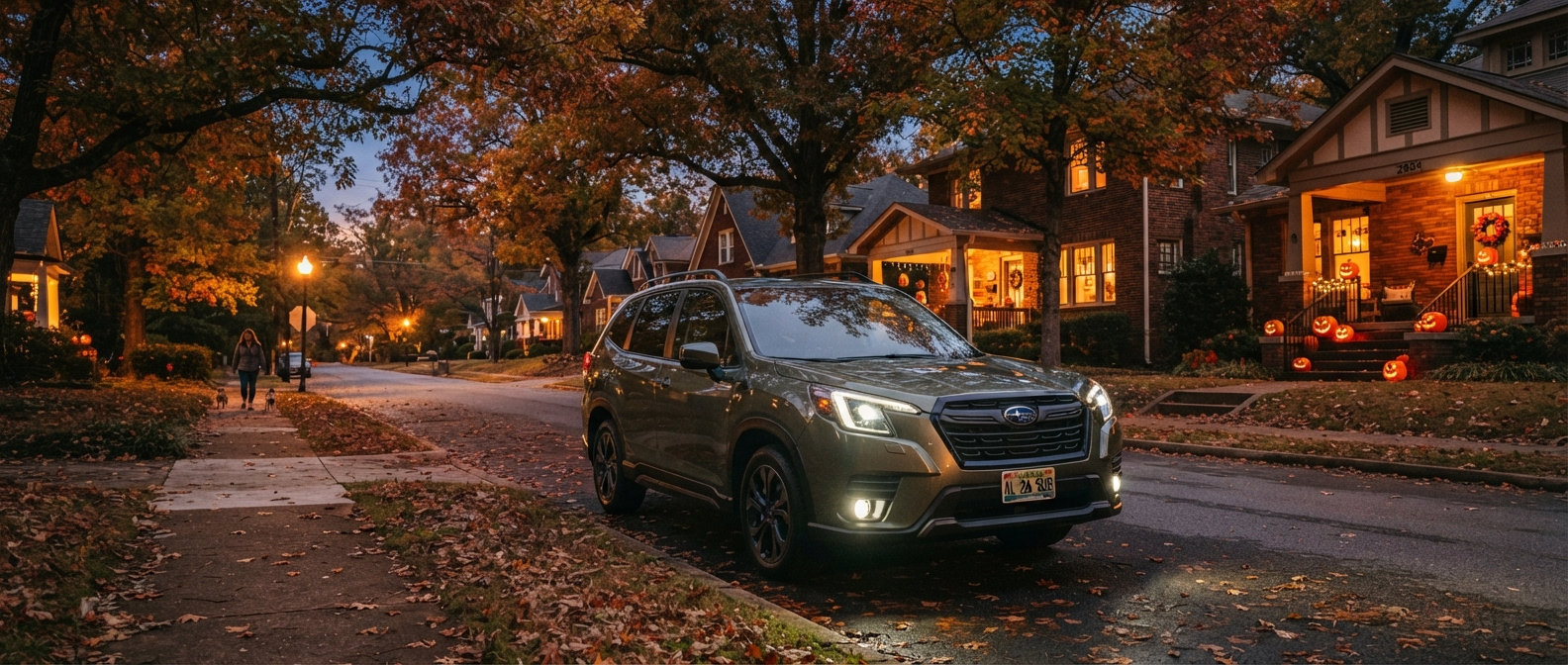
Tonight is the one night a year when residential streets in Birmingham behave nothing like they normally do. Kids in dark costumes dart between parked cars. Groups cross mid-block without looking. Driveways that are usually clear fill up with clusters of children waiting at the door. The core answer is simple. Slow down to well under the posted limit before you even enter a residential block, turn your headlights on now if they aren't already, and treat every parked car as a potential obstacle with a child on the other side of it.
Your Subaru Forester, Outback, or Ascent has EyeSight on board, and that genuinely helps. But EyeSight is a support system that can't replace your own attention. We'll walk through what it does and where it hands the responsibility back to you.
What to Do and What to Skip: Halloween Residential Driving
| Do | Don't |
|---|---|
| Turn headlights on before sunset | Rely on daytime running lights alone |
| Drop to 10-15 mph on residential blocks | Drive the posted limit through active trick-or-treat zones |
| Stop completely before driveways and alleys | Roll slowly through without a full stop |
| Scan parked cars for feet or movement underneath | Look only at the center of the road |
| Give pedestrians the right-of-way even mid-block | Wait for a crosswalk to yield |
| Put the phone face-down before entering the neighborhood | Glance at it at a red light |
| Allow extra following distance behind the car ahead | Maintain your normal gap |
Per NHTSA's Halloween safety guidance, children may be unaware of traffic and dart into the street unexpectedly. We don't offer that as hyperbole. It's the specific behavior that makes neighborhood driving tonight different from every other Thursday.
The Technique That Actually Changes the Outcome
Speed is the one variable that decides how every other choice plays out tonight, since it sets both how far you travel before you react and whether EyeSight can avoid a collision or only soften one. Get the speed right and everything downstream gets easier.
- Lower your speed before the first house, not after you see someone. Reaction time is fixed. At 20 mph you travel about 30 feet before your foot moves off the accelerator. At 12 mph that shrinks to roughly 18 feet. Entering a neighborhood at 12 mph or below gives you the room to respond to an unexpected dart.
- Use your low beams, not high beams. High beams can blind children approaching from the side and keep them from judging whether you're slowing. Standard low beams light plenty of road for residential speeds and don't throw the same glare.
- Treat every parked car as a potential concealment point. Kids step straight into the street from between parked vehicles. Move toward the center of the lane when a row of parked cars lines the curb, and you'll buy yourself an extra second of visibility.
- Stop fully before backing out of any driveway. Check your mirrors, then pause. Your rear cross-traffic alert comes standard on Outback, Forester, and Subaru Ascent trims with EyeSight, and it can detect movement approaching from the sides, though it works best when the car is fully stopped and you're watching the display.
- Put the neighborhood on active attention, not cruise. We know EyeSight's Adaptive Cruise Control is smooth and easy on a commute. Tonight isn't the commute. Turn it off in residential zones. You want your foot over the brake and ready.
Schedule a Pre-Holiday Safety Check
One thing we want Subaru drivers to know: EyeSight's pre-collision braking can detect pedestrians in the vehicle's path at low residential speeds, and the IIHS's Highway Loss Data Institute found that vehicles equipped with EyeSight showed a 35% reduction in pedestrian-related bodily injury claim frequency compared to the same models without the system. That figure means something. But EyeSight works best when the driver is already doing the basics right, with slow speed, attention forward, and the phone down. The system is a genuine second set of eyes, and you're still the first.
What EyeSight Does (and Where You're Still in Charge)
The Subaru Outback, Forester, and Ascent all carry EyeSight standard for 2026, and all three earned IIHS TOP SAFETY PICK+ this year in ratings that include pedestrian crash prevention testing. That matters because the testing is rigorous and the result applies to real conditions, well beyond a closed course.
What does EyeSight actually do tonight? Its stereo cameras scan forward continuously, identifying pedestrians by their size, shape, and movement. At low residential speeds (below approximately 19 mph), EyeSight can apply full braking force to avoid a pedestrian collision if the driver hasn't responded. At higher speeds it can still apply the brakes to reduce severity, but it can't guarantee avoidance. The tradeoff is real. If you're moving through a neighborhood at 25 mph, EyeSight is working, but it's working to soften the hit rather than prevent it. Keeping your speed in the 10-15 mph range on active blocks puts the system in the operating range where it can do the most for you.
EyeSight relies on cameras rather than radar, and the cameras read the road ahead through the top of your windshield. Fogged or dirty glass directly in front of them can degrade detection quality. If you haven't already, give the inside of your windshield a quick wipe before tonight.
The Subaru Crosstrek carries EyeSight too, and the same logic applies no matter which model sits in your driveway. Slow down, lights on, phone away. EyeSight is with you. Make sure your attention is, too.
Drive Carefully Tonight, Birmingham
Halloween falls on a Saturday this year in Birmingham, which means trick-or-treat hours will run later and volume will be higher than a weeknight. The eastern suburbs along Grants Mill Road and the Mountain Brook and Irondale neighborhoods tend to draw exactly that kind of long, high-traffic evening. Keep the speed low, keep the lights on, and let EyeSight do what it was built to do alongside you, not instead of you.
Categorías:
Social