


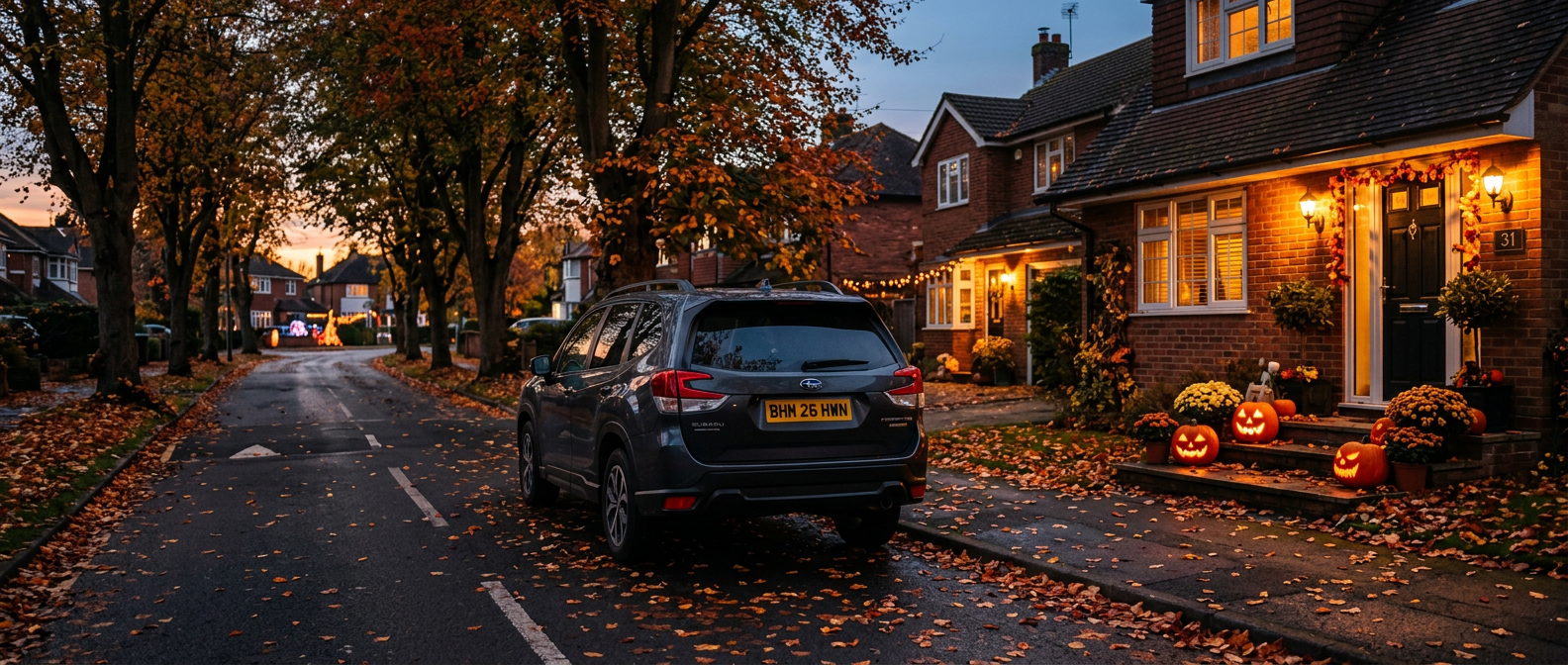
Halloween is the one evening each year when a JAMA Pediatrics study of 42 years of data found pedestrian fatality risk runs 43% higher than on comparable nights. Tonight also lands on Magic City Classic Saturday. So I-20 and the downtown corridors will be carrying parade-day traffic at the exact moment families are loading into cars for neighborhood trick-or-treating across the eastern suburbs. The combination is specific to Birmingham this year, and it's why we put this guide together.
A standard pre-drive setup check on your Subaru (windshield, EyeSight, headlights, mirrors) takes about ten minutes. Done right, it's the difference between running EyeSight at full capacity on the night you need it and running it degraded by something as simple as a dirty windshield.
The 2026 Forester and every current Subaru in our lineup ships with EyeSight standard. If you already have it and want to use it correctly, this guide is for you.
EyeSight uses stereo cameras mounted at the top of your windshield. Dirt, condensation, or smudging on that part of the glass can disable the system entirely without any warning until you check. Clean the windshield before you drive tonight.
What You Need Before You Start
You won't need any specialized tools for tonight's check, which is really the point of running it at home rather than booking it somewhere, because everything in the table below is already sitting in your car or your garage, from a microfiber cloth to glass cleaner to the washer fluid you'd top off for a rainy commute anyway. Gather it before dark and the whole thing moves fast.
| Item | What it's for | Notes |
|---|---|---|
| Microfiber cloth | Inside windshield cleaning | Avoid paper towels, which can scratch the camera zone |
| Glass cleaner | Interior windshield film removal | Apply to cloth, not directly to glass near camera housing |
| Washer fluid level check | Exterior cleaning during the drive | Top off before dark if it's below half |
| Working wiper blades | Clearing rain and road spray | Streaky blades cause EyeSight to degrade in wet conditions |
| Functioning headlights | Visibility and pedestrian detection | Switch to low-beam manually before entering neighborhoods |
| Adjusted mirrors | Checking the sides at intersections | Rear and side both; check now, not at the first stop sign |
Per Subaru's published EyeSight owner guidance, if the windshield washer is in use or if raindrops and dirt on the windshield are not wiped off sufficiently, those conditions reduce the stereo camera's field of view. Tonight is not the night to find that out.
The Pre-Drive Setup: Six Steps
Run these six steps in order, inside the garage or driveway and before you ever pull out, because each one sets up the next and skipping around tends to leave something half-checked right when you need it working. The whole sequence takes about ten minutes.
Step 1: Clean the interior windshield, top section first.
The EyeSight cameras sit behind a wide black housing at the top center of your windshield. Spray your microfiber cloth with glass cleaner and wipe that section in horizontal strokes. Don't spray directly onto the housing or try to clean the lens itself. The cameras are precision optics. Per Subaru's own documentation, the lenses should never be touched or wiped directly, so what you're cleaning is the glass in front of them.
Step 2: Check the exterior windshield and wiper condition.
Walk to the front of the car and look at the glass in the camera zone from outside. Road grime builds up in a thin film that's easy to miss from the driver's seat but still affects how clearly EyeSight reads what's ahead. Run your wipers for ten seconds with washer fluid and check whether they clear the glass completely without streaking. Streaky blades are one of the most common reasons EyeSight warns or goes inactive in wet weather. If your blades are leaving arcs, swap them before tonight. A set takes five minutes to install.
Step 3: Top off your washer fluid.
Birmingham gets unexpected late-October rain. Leaf debris and road grime build up fast on a damp evening, and you'll burn through more fluid than you'd expect driving a busy neighborhood. Fill the reservoir before you leave. Our Outback owners and anyone else whose service visit is overdue, this is also the right moment to confirm the reservoir isn't flagging something else you've been putting off.
Step 4: Adjust all three mirrors before you move.
Do this in the driveway. Set your side mirrors so the edge of your car is just barely visible on the inboard edge of each one. That widens your view of the sidewalk and the curb lines where children will be walking. Set the rearview for your current driving position, not the one left over from your last commute. Adjusting mirrors while you're rolling through a neighborhood is exactly the kind of distraction Halloween night doesn't need.
Step 5: Test your headlights and set them to auto or low-beam.
High beams wash out pedestrians at close range and make it harder, not easier, to spot someone stepping off a curb. Set to low-beam or auto. NHTSA advises that 76 percent of pedestrian fatalities in traffic occur in dark conditions with or without artificial lighting, so the goal is controlled illumination that lets your eyes and EyeSight work together, not a light source so bright it flattens contrast. Walk around the car and confirm both low beams are lit. This sounds obvious. You'd be surprised how often a burned-out headlight goes unnoticed for a week.
Step 6: Brief anyone in the car before you leave.
If you're driving kids between neighborhoods or picking up passengers from a trunk-or-treat, set the expectation before the engine starts. One adult handles navigation and directions; you handle the wheel. Nobody adjusts the radio, nobody passes candy forward, nobody hands you the map app while you're moving. Subaru's own documentation notes that even a brief obstruction of the camera housing (a hand, a bag, a stray sleeve) will cause EyeSight to stop operating. An undistracted driver with a clean windshield and working EyeSight is the full package.
What EyeSight does not do tonight: EyeSight is a camera-based system, and camera performance drops in very low light. The system can and does detect pedestrians in partial darkness. In full-dark conditions, though (an unlit street between pools of porch light), it's simply less capable, and no amount of windshield prep changes that. The step that's easy to skip is understanding that limit, because understanding it changes how you drive. Slow down more in dark stretches than you would on a lit block. EyeSight helps, and your foot on the brake is the backup it leans on.
Why Birmingham Tonight Is Different From a Typical Halloween
The 85th Magic City Classic runs at Legion Field on October 31 this year, and the parade steps off downtown in the morning, which means I-20 inbound and the surface streets around downtown will carry residual crowd traffic through the afternoon and into the early evening, right as neighborhood trick-or-treating starts to build. By 5:30 or 6 p.m., when that trick-or-treating peaks, the traffic is merging with family carpools heading into residential streets in Irondale, Mountain Brook, and the Grants Mill corridor.
JAMA Pediatrics data puts the peak risk window between 5 and 9 p.m., with the single riskiest hour at 6 to 7 p.m., as sunset and rising pedestrian density overlap. In an ordinary year, that's already the hour to slow down. In a year where downtown crowd dispersal runs on the same timeline, the arterial routes into the eastern suburbs will carry unusually mixed traffic. Leave extra gap between you and the car ahead. Residential streets where children are moving door-to-door will have parents following in cars at low speed. Expect frequent unannounced stops.
Book a Pre-Halloween Service Check
Quick-Reference Card: Halloween Night in Your Subaru
Print this card or screenshot it before you head out tonight, and keep it somewhere you can glance at without reaching, because the three columns below cover the before-you-leave check, the while-driving habits, and the passenger rules in one place. Run it top to bottom.
| Before you leave | While driving | If you have passengers |
|---|---|---|
| Clean interior windshield (camera zone) | Headlights on before dusk | One adult handles nav only |
| Check wiper blade condition | Low-beam in neighborhoods | No passing items to the driver |
| Top off washer fluid | Extra gap behind slow-moving cars | Bags and costume items stored, not on laps |
| Adjust mirrors in the driveway | Slow below the posted limit in residential zones | Kids in back seat, belted, before the car moves |
| Confirm both headlights lit | Pause fully at every driveway, not just crosswalks | |
| Note EyeSight operates at reduced confidence in full dark |
We have the full 2026 lineup on the lot if tonight's drive prompts any questions about upgrading to a current EyeSight configuration.
Safe Halloween from the team at Hallmark Subaru Birmingham.
By the Hallmark Subaru Birmingham Team | October 2026
Frequently Asked Questions
Does EyeSight work at night for detecting trick-or-treaters?
EyeSight can detect pedestrians in partial low-light conditions, but it's a camera-based system, and its performance drops in full darkness compared with well-lit conditions. Subaru's own documentation confirms that driving in complete darkness with no detectable objects ahead can limit system operation. Treat EyeSight as a supplemental layer on Halloween night, not a primary one. The most reliable protection is driving at reduced speed through residential streets and pausing fully at every driveway and curb cut.
What is the riskiest time window for driving on Halloween night?
According to a 42-year JAMA Pediatrics study, pedestrian fatality risk is 43% higher on Halloween evenings than on comparable nights. The peak risk hour in that study was 6 to 7 p.m., the window when sunset overlaps with peak trick-or-treating activity. NHTSA also notes that 76 percent of pedestrian fatalities in traffic occur in dark conditions. If you can, plan your Halloween driving to be off the road or parked during the 6 to 7 p.m. hour, and if you have to drive then, treat every block as a school-zone speed.
Categorías:
Social