

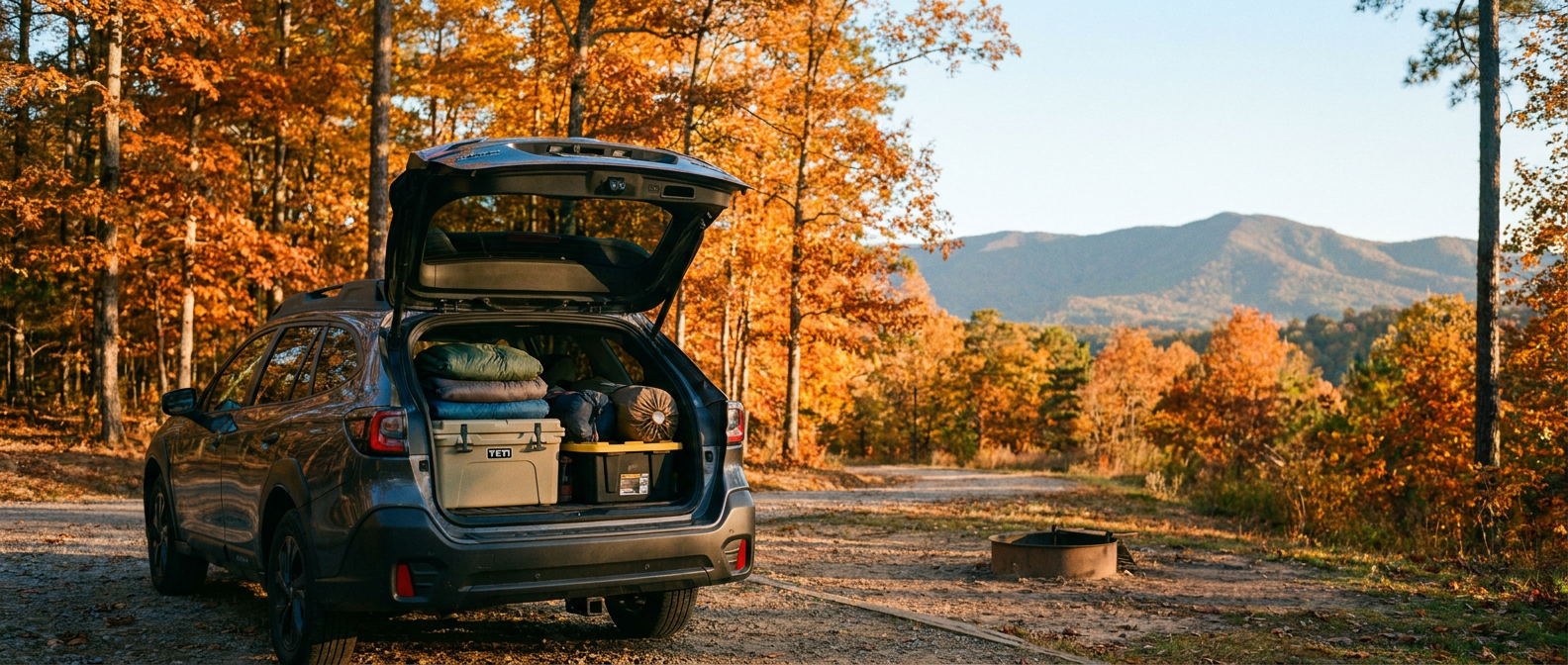
The honest answer is you pack it in two completely different configurations depending on whether you're carrying passengers, and the Outback's cargo geometry rewards the campers who sort that out before they're standing in the driveway at 6 a.m. trying to close the liftgate.
The 2026 Outback ships with 34.6 cubic feet behind the rear seats, and it opens to 80.5 cubic feet once you fold them. People quote that figure all day. The one that actually matters for tent-and-cooler logistics is 42.8 inches, the cargo floor length behind row two with all four adults still aboard. Know that number before you buy the tent, and you'll pack differently.
Alabama fall camping makes its own demands. Cheaha State Park sits at 2,407 feet, the highest point in the state, and in late October it runs roughly 20 degrees cooler than Birmingham down at the trailhead. You'll leave Grants Mill Road in a light jacket and unzip a second layer by the time you reach the overlook. Pack for that temperature swing, not for what the weather app shows at your zip code.
The Outback's flat-folding rear seats and 80.5 cubic feet of total cargo space handle a full two-person camp setup comfortably, but the 31.5-inch cargo height is the real constraint on what gear stacks cleanly.
How Does the Outback's Cargo System Actually Work?
The cargo system works around a low, flat load floor, and that single design choice sets the Outback apart from taller SUVs with higher step-in heights. Fold the rear seats and you get 75.9 inches of floor length from the tailgate opening to the back of the front seats. Long enough to sleep two adults with heads pointed toward the front, though it's a firm surface without a pad. The seats fold essentially flat, with no pronounced ledge between the seatback and the floor, which matters when you're sliding a soft-sided cooler or a rolled sleeping bag in at 10 p.m. by headlamp.
Where's the limit on all this? The cargo height of 31.5 inches sets it. You can fit a duffel, a sleep system in its compression bag, and a 45-quart soft cooler stacked under that ceiling. Things get tight once you add a rigid-walled cooler plus a two-person tent box plus a camp chair on top. You can do it, you'll just have to decide which items ride inside versus up on the roof rails.
Here's a quick comparison that helps you plan.
| Packing Scenario | Seats Up (42.8" floor) | Seats Down (75.9" floor) | What This Means for Your Trip |
|---|---|---|---|
| Two adults + gear | Yes, one gear zone | No (passenger space needed) | Cooler + bags behind row 2; bulky items on roof |
| Two people, car-camping solo night | Yes, with fold | Full flat floor for sleeping | 80.5 cu ft; 6-foot adults fit diagonally |
| Solo camper, gear-heavy | Fold one side | Full or 60/40 split | Use the 60/40 fold to carry one passenger + full gear on the other side |
| Bike or kayak day-trip added | Seats down, roof rails active | Combined inside + roof | Standard roof rails, Subaru-listed 165-lb static roof load capacity |
The standard roof rails on the 2026 Outback carry up to 165 pounds of static load (per Subaru's published specs), and they're heavy-duty units. A rooftop cargo box for wet gear and a camp chair fits without drama. Those rails let you haul more people without surrendering the gear. So you keep the people and the gear.
What Does the Alabama Fall Climate Actually Demand From Your Load?
The Alabama fall climate demands layering more than bulk, because the swing between Birmingham and Cheaha's summit runs wide enough that one heavy coat can't cover it, and a generic fall packing list written for, say, Vermont in October will steer you wrong here. Cheaha is not Vermont, and Birmingham is not the same altitude as Cheaha.
The Forester community talks about this plenty in the outdoor forums, and Outback owners hit the same situation. You leave the eastern suburbs in what feels like light-jacket weather (mid-60s in Birmingham in late October), and you arrive at Cheaha's upper campground in temperatures that can dip into the upper 30s overnight. Alabama State Parks data puts fall temperatures at Cheaha in the 38 to 84 degree Fahrenheit range across the season. The summit wind doesn't care what your weather app said at home.
The practical cargo implication comes down to volume. Layering systems pack smaller than bulk insulation. A moisture-wicking base layer, a fleece mid-layer, and a packable shell take about the same compressed volume as one heavy cotton hoodie, and they'll do four times the work across a temperature swing that wide.
What that'll mean for your Outback load breaks into a few specifics.
- Sleeping bags rated to 20 degrees F compress into manageable cylinders; an unrated camp blanket won't. Use the compression bag.
- A 3-season tent with a rain fly is the call for late-October Cheaha, the elevation brings real wind and occasional overnight rain, and the campground reviews specifically flag securing gear against fall gusts, so you'll want stakes that hold.
- Soft-sided coolers over rigid ones when you're carrying four people and need that 42.8-inch rear zone for people and gear. Rigid coolers go in when the seats are down.
- Firewood source matters. Alabama prohibits transporting firewood from outside the forest to prevent invasive species spread, and Cheaha has firewood available on-site, so you'll leave that one off the cargo list.
Which Outback Trim Makes the Most Sense for This Kind of Trip?
For most Cheaha trips the 2.5L trims make the most sense, even though the lineup runs to six and the turbo trims look tempting on paper, because the camping use case narrows the choice faster than you'd expect. The 2.5L BOXER engine in the Premium, Limited, and Touring produces 180 horsepower and 178 pound-feet of torque, rated for 2,700 pounds of towing when properly equipped. Enough for a teardrop trailer if that's your direction. The 2.4L turbocharged XT and Wilderness trims step up to 3,500 pounds of tow capacity when properly equipped.
For a Cheaha-style trip. No trailer, loaded cargo, and Talladega Scenic Drive on the agenda, the 2.5L trims are genuinely sufficient. The Wilderness adds 9.5 inches of ground clearance (versus 8.7 on standard trims) and all-terrain tires, which you won't need for the paved campground access road. Where the Wilderness earns its keep is if you're camping at dispersed primitive sites in the Talladega National Forest that surrounds the park, where the trail surface runs uneven and unpaved.
The Forester is worth a look if your priority is parking ease around the campground loop and you're carrying two people rather than four. The tradeoff is real, though. It gives up about 15 cubic feet of maximum cargo volume compared with the Outback, and that's a meaningful difference when you're loading a two-person tent plus sleeping systems plus kitchen gear.
A plain summary sorts the trims for camping use, and it's quick.
| Trim | Engine | Ground Clearance | Max Tow (when properly equipped) | Best Camping Scenario |
|---|---|---|---|---|
| Premium / Limited / Touring | 2.5L BOXER 180 hp | 8.7 in | 2,700 lbs | Cheaha campground, day-hiking, no trailer |
| Limited XT / Touring XT | 2.4L Turbo BOXER | 8.7 in | 3,500 lbs | Teardrop or utility trailer campers |
| Wilderness | 2.4L Turbo BOXER | 9.5 in | 3,500 lbs | Dispersed camping, unpaved forest roads, rooftop tent use |
The EyeSight driver assist system is standard on all 2026 Outback trims. On the Touring and above, it includes hands-free highway driving assistance up to 85 mph, which covers most of US-280 east and I-20 toward the park. You'll feel it on a loaded, tired drive home Sunday evening.
A note from our team: A pattern worth flagging from our team at Hallmark Subaru Birmingham is how easy it is to underestimate Cheaha's overnight low. The weather forecast for Birmingham on Friday afternoon and the temperature at Cheaha Upper Campground at 2 a.m. Saturday aren't the same number. The 8.7 inches of ground clearance and Symmetrical All-Wheel Drive on every 2026 Outback handle the road conditions without drama, so give the gear layering for the occupants the same attention as the vehicle's capability.
Glossary: Outback Camping Terms You'll Actually Use
| Term | What It Means for Your Trip |
|---|---|
| Cargo Volume (seats up) | 34.6 cu ft, the usable zone behind row 2 with passengers aboard |
| Cargo Volume (seats down) | 80.5 cu ft. Full flat floor when you fold both rear seatbacks |
| Static Roof Load | 165 lbs, the weight limit for items secured to the standard roof rails |
| Symmetrical AWD | Subaru's all-wheel-drive layout that distributes engine torque to all four wheels continuously, not on-demand |
| X-Mode | The terrain management system on Outback trims that adjusts throttle, brakes, and AWD torque split for low-traction surfaces |
| Cargo Area Length (Row 2 up) | 42.8 in, the floor-to-liftgate measurement that dictates what fits behind seated passengers |
What This Means for Your Next Vehicle Choice
If your fall calendar includes anything between Birmingham and Cheaha, or the Talladega National Forest, or the backroads of Cleburne County, the Outback's combination of genuine cargo volume, 8.7 inches of ground clearance, and standard Symmetrical AWD fits that use case without over-buying. You don't need a truck. You probably don't need the Wilderness trim either, unless dispersed primitive camping is a regular item on your list.
The honest tradeoff runs like this. The Outback carries more than the Crosstrek and parks more easily than the three-row Ascent. If you're regularly camping with more than four people, the Ascent's third row and additional cargo architecture make a stronger case. For a family of four heading to Cheaha, the Outback is the right-sized answer, most trips anyway.
If you want to see what's currently on our lot, or talk through which trim makes sense for how you actually use the vehicle, our team is at 1837 Grants Mill Road in Birmingham. We know this market and we know these vehicles.
Frequently Asked Questions
Will a two-person tent fit inside a 2026 Outback with the rear seats folded?
Most two-person backpacking tents in their stuff sack will fit inside the 2026 Outback with the rear seats folded flat, which opens 75.9 inches of floor length. A standard two-person freestanding tent in its packed bag (typically 20-24 inches long) fits with room to spare alongside sleeping bags and a soft cooler. Larger dome tents with rigid poles in a bag exceeding 24 inches will still fit; the 31.5-inch cargo height is the constraint to check against large folded tent bags, not the floor length. Seats-up, the 42.8-inch floor length behind row two handles carry-on-sized bags and soft gear, but a tent bag typically needs the seats down.
Does the 2026 Outback have enough ground clearance for Alabama forest roads?
The 2026 Outback has 8.7 inches of ground clearance on standard trims and 9.5 inches on the Wilderness, per Subaru's published specifications. For paved and well-graded gravel access roads like the approach to Cheaha State Park's campgrounds, 8.7 inches is adequate. For rougher unpaved two-tracks in the Talladega National Forest, the Wilderness trim's additional clearance and all-terrain tires add a meaningful margin. Symmetrical AWD is standard on every 2026 Outback trim.
Categories:
Social