

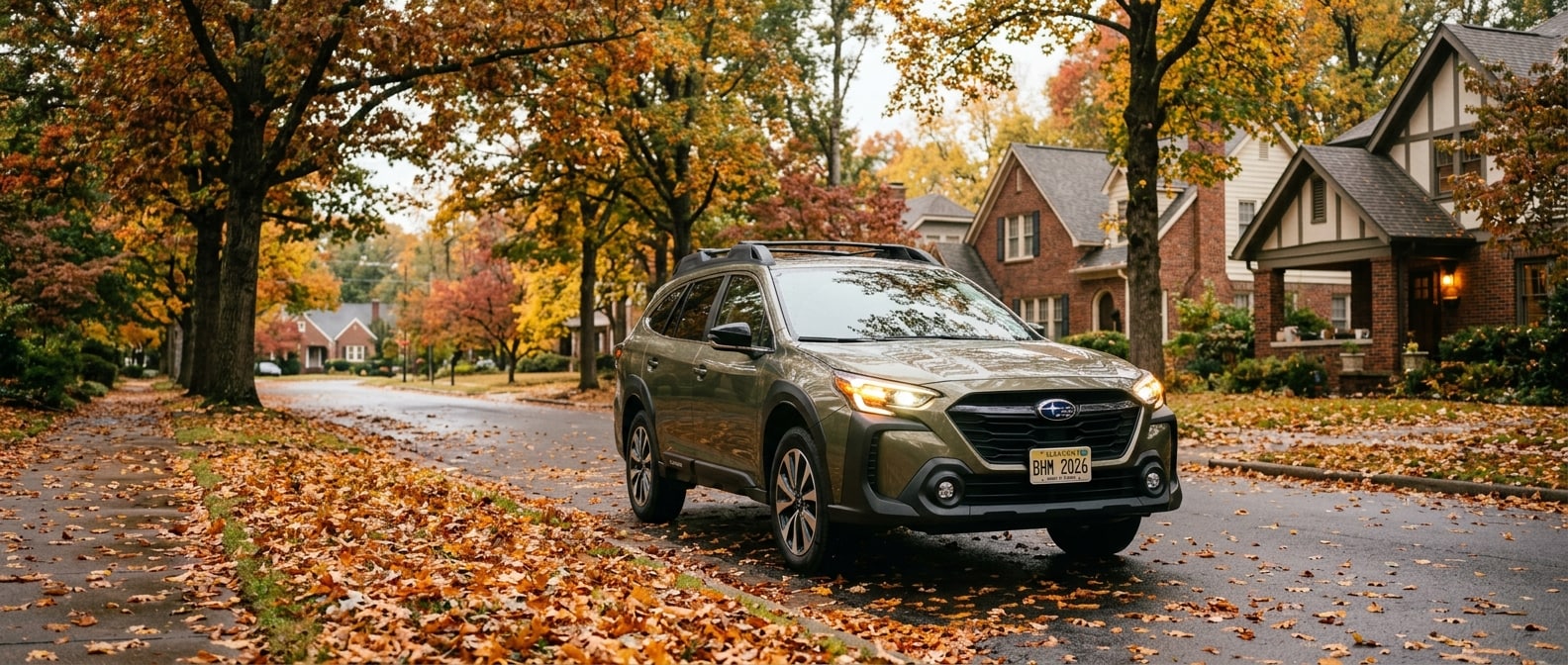
Right now in Birmingham, sunset arrives before 6:30 PM and loses another minute or two every single day. Once the clocks fall back on November 1, you'll be driving home in the dark by 5 in the afternoon. The shift happens fast, and your Subaru tends to flag it before the change feels obvious from the driver's seat. Three symptoms show up, and they look like three separate problems. They aren't separate at all. Each one traces back to the same seasonal transition, and each one has a clear fix.
Before the issues stack up, schedule a fall check-up with our service team.
What's Actually Going On With Your Subaru This Fall?
Fall in central Alabama changes your Subaru's operating environment faster than it changes the scenery, and three things tend to arrive together once the temperature drops: a TPMS light on cold mornings, EyeSight dropouts in rain, and wipers that smear instead of clear. Each is a real symptom, though they share one root cause. The leaves are pleasant. Less pleasant is a TPMS warning light on a cold Tuesday morning, an EyeSight system that keeps dropping out in rain, and wiper blades that leave a greasy film across your windshield right when you need them most.
Each of those reads as a distinct symptom. They share a common cause, though. Your Subaru's systems were set up in the heat of summer, and fall just changed the operating environment. Below is what each symptom likely means and what to do about it.
| Symptom | Likely Cause | What To Do |
|---|---|---|
| TPMS amber light on cold mornings, goes off after driving | Temperature drop reduced tire pressure (roughly 1 PSI per 10 degrees F) | Check cold pressure against the door-jamb spec; inflate, then drive 10-15 minutes to clear the light |
| EyeSight system shows "temporarily unavailable" in rain or at dawn/dusk | Fogged or film-covered windshield area in front of the stereo cameras | Run the defroster to clear the camera zone; replace wiper blades if they're leaving streaks |
| Wiper blades chattering, skipping, or leaving a greasy arc | UV and summer heat have degraded the blade rubber | Replace blades; Subaru recommends inspection every 6-12 months and replacement when streaking starts |
| High beams not switching on automatically on dark back roads | High Beam Assist only activates above 20 mph with headlights in Auto mode and stalk pushed forward | Confirm Auto mode is on and the high-beam stalk is fully pushed forward |
The TPMS Morning Light: Not a Slow Leak
If the tire pressure light showed up this morning, it usually means at least one tire is genuinely low, but this time of year the most common trigger is a cold snap rather than a leak. Pressure drops about 1 PSI per 10 degrees Fahrenheit, so the light can appear on the first cold morning with nothing actually wrong.
Birmingham's October mornings are arriving in the mid-to-upper 40s after weeks of summer heat, which is a meaningful swing. As temperatures fall, the air inside your tires becomes denser and PSI drops with it. For every 10-degree drop in temperature, tire pressure can fall by about 1 to 2 PSI. Set your tires on a warm afternoon, let a cold front move through overnight, and the math works against you before you've touched the ignition.
The fix is straightforward, so start by adjusting all tires to the door-jamb placard spec while they're cold. Drive above 20 mph for 10 to 15 consecutive minutes. The sensors transmit healthy pressures and the light clears itself. No reset button, no menu calibration needed. Just inflate and drive.
The Forester and Outback both carry their recommended cold-tire PSI on the driver-side door-jamb label. Check that sticker rather than the number molded into the tire sidewall, which lists the maximum instead of the target.
One caveat is worth flagging. If the light stays on after you've corrected the pressure and driven a few miles, or if one tire runs consistently lower than the others, have our service team check for a valve stem issue or a slow puncture. Seasonal pressure fluctuation is normal. A tire that keeps underperforming the others is a different conversation.
Watch the low-sun glare, too. October brings a sun angle that hits Birmingham commuters squarely in the eye during the 7 AM and 5 PM rush. Keep your windshield inside and out clean of film; haze that was invisible in summer becomes a serious glare source when the sun is low.
EyeSight's stereo cameras read the road through the windshield: worn wipers that leave streaks across that glass can cause the system to temporarily suspend itself, exactly when fall driving conditions need it most.
EyeSight Dropouts: The Windshield Is the Real Culprit
EyeSight dropping out in the rain usually traces back to the windshield rather than the cameras, and the glass right in front of those cameras is exactly where fall conditions do their damage. You can be on I-20 in a light rain with EyeSight working fine for months, and then the dashboard shows "EyeSight Temporarily Unavailable." Nothing felt different from the driver's seat, but something did change.
EyeSight's automatic High Beam Assist leverages the same system of sensors and outward-facing cameras that power the rest of EyeSight. Through advanced processing, the system can identify ambient light conditions and recognize objects like other vehicles, streetlights, and even pedestrians. Those cameras read the world through a specific section of your windshield, right at the top near the rearview mirror. If anything compromises that patch of glass, the system suspends itself rather than operate on bad data.
Bad weather and windshield film are the most common triggers. Heavy rain or thick fog can affect the system. In particular, EyeSight is more likely to stop operating for a while when there's an oil film on the windshield, a glass coating has been applied, or poorly performing wipers are used. That last part is the one worth underlining. Wiper blades that were adequate in summer heat can develop micro-tears in the rubber that leave a thin film across the glass rather than clearing it cleanly. The driver doesn't always notice. The EyeSight cameras do.
On cold or frosty mornings, EyeSight may show as unavailable until the defroster gets going. If this happens to you, run the front defroster for a few minutes and let the cameras clear before you pull out. EyeSight resumes on its own once the obstruction clears.
Worth knowing here, EyeSight suspending itself is the system doing its job. The transparent design keeps the vehicle from making safety interventions based on obscured or degraded visual data. It's still a signal that your windshield and wiper condition need attention.
Crosstrek owners should also confirm that the camera zone at the top of the windshield is free of any parking stickers or tinting film, both of which can aggravate EyeSight sensitivity in low-contrast fall light.
Wiper Blades: The Maintenance Item That Affects More Than Wipers
Birmingham's summer heat is genuinely hard on wiper blade rubber, so a blade that cleared the windshield cleanly in March has often developed surface cracking by September, even if it still looks fine at a glance. The tell is a chattering noise, a smeared arc instead of a clean sweep, or that greasy-film residue that comes back with the next wipe.
Subaru recommends inspecting your wipers on a regular basis and expecting to replace them about every 6 to 12 months, depending on usage and local weather conditions. If you're noticing streaks, squeaking, or missed spots, it's time for a new set.
Sizes vary by model. For the Crosstrek, you're looking at a 26-inch driver's blade and a 16-inch passenger blade. The Outback runs 26 inches on the driver's side and 18 inches on the passenger side. On the Forester, it's 26 inches driver and 16 inches passenger. All three use a 14-inch rear blade. Get the rear wiper, too. That back glass fogs in the transition between warm interior air and cool fall mornings, and a worn rear blade turns clearing it into a frustrating exercise.
Using OEM blades ensures a perfect fit and better performance for your specific Subaru model. They also keep the EyeSight camera zone clearing properly. We're not making a sales pitch here, we're repeating what the owner's manual specifies.
DIY vs. Letting Our Team Handle It
Most of the fall preparation above is genuinely DIY-friendly, and you can knock out tire pressure, wiper blades, and the defroster habit in a driveway afternoon, but a handful of symptoms are worth bringing to the counter instead of chasing on your own. The line sits where a fix stops being a quick swap and starts being a diagnosis.
Handle it yourself:
- Check tire pressure against the door-jamb placard on a cold morning (before you drive more than a mile or two, while tires are still cold)
- Replace wiper blades using the sizes above (hook-style connector, typically done in under five minutes per blade)
- Run the front defroster on cold mornings before EyeSight needs to operate
- Confirm your headlight switch is in Auto mode and the high-beam stalk is pushed fully forward if High Beam Assist isn't engaging
Let our service team handle it:
- TPMS light that won't clear after you've corrected all four tires and driven 15+ minutes
- EyeSight that shows as unavailable even on a clear, dry morning with clean glass
- A wiper blade you replaced that still leaves streaks (often a sign the windshield itself has an oil film or hard-water residue that needs a proper cleaning)
- Any unusual vibration when braking, which fall tire-pressure swings can make more noticeable but which are usually a separate issue
Schedule a service appointment and our team can go through the whole list in one visit. Catching these in early October is faster than troubleshooting them one by one through November.
Frequently Asked Questions
Why does my Subaru's TPMS light come on in the morning and turn off by itself after I start driving?
You're seeing the most common fall tire-pressure pattern. A temperature drop pulls pressure down roughly 1 PSI per 10 degrees Fahrenheit. A tire set to 35 PSI on a warm evening can read in the high 20s after a cold night, which is enough to trip the warning light with nothing actually wrong. As you drive, the tires warm up and pressure climbs back into range, so the light clears on its own. The right move is to check and correct the cold pressure in the morning (before driving, against the door-jamb spec) instead of waiting for the light to go off. That way you're running the correct pressure, not pressure that just happens to sit above the warning threshold.
Does High Beam Assist work automatically, or do I need to set something up?
High Beam Assist offers the dual benefit of maximizing nighttime visibility and making the driver's job easier by adjusting high beams on its own. As part of EyeSight Driver Assist Technology, High Beam Assist surveys the vehicle's surroundings and engages headlights in darkness. The system intelligently switches between high and low settings as needed to provide optimal visibility without compromising visibility for other drivers. But it does require a two-step setup. Your headlight switch needs to be in the Auto position, and you need to push the high-beam stalk fully forward and lock it there. With both engaged, High Beam Assist handles the switching on its own. If only one of those two conditions is met, the feature won't activate.
Categorías:
Social