


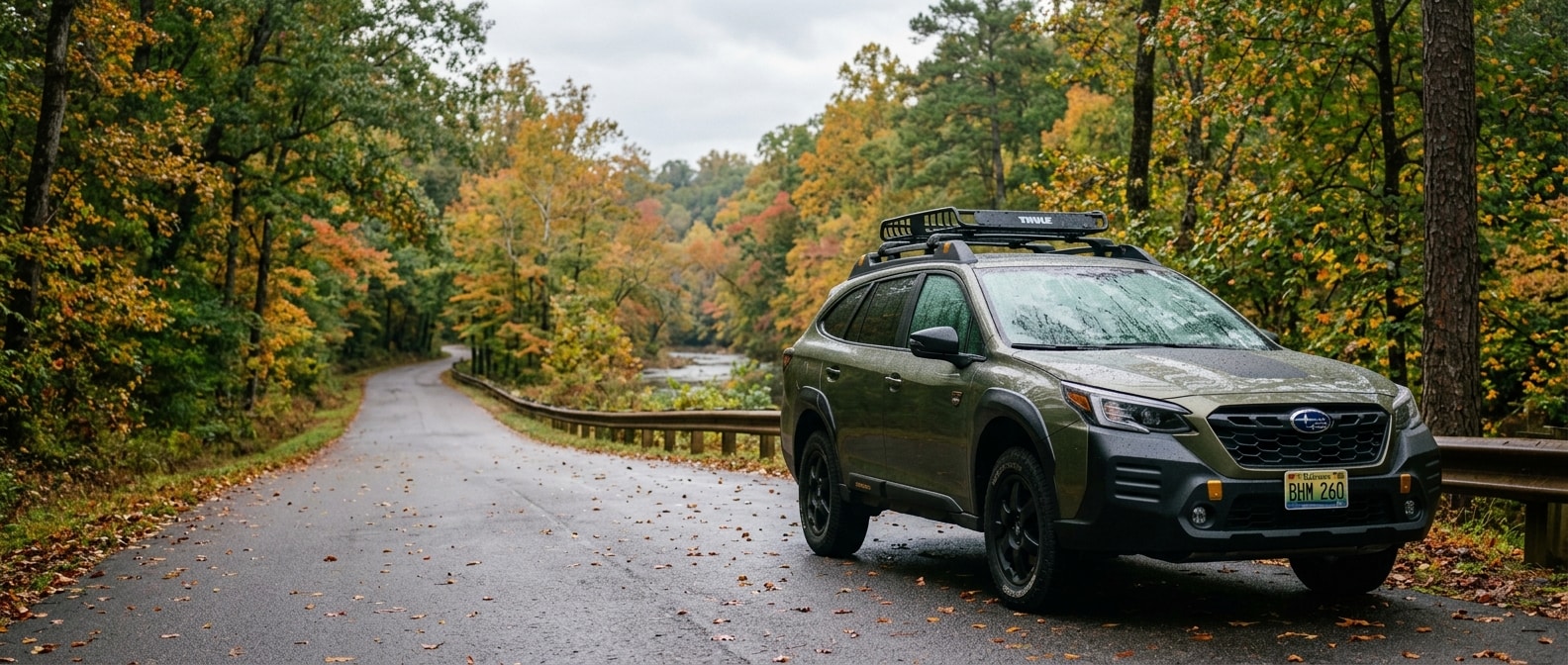
October in Birmingham plays tricks on you. The first of the month can hit 89 degrees, and the last week can drop to 52 at night. Between those two points your Subaru lives through a 35-plus-degree swing in overnight lows, and every system on the car notices it in a way a long Alabama summer never really forces.
So what should you do before the season turns? Don't wait for the TPMS light to explain it to you. Plan one Saturday morning, work through five quick checks, and your car is ready for whatever October and November throw at it, including the Outback loaded up for Cheaha when the foliage peaks in a few weeks.
Here is the plan, and here's why each stop actually matters.
What's the Route?
Five quick checks will take you roughly two to three hours in total, and that assumes you knock out the easy driveway ones yourself first before bringing the car in to us for everything that's left. We'd run them in that sequence, driveway first and the service bay second.
| Stop | Where | What You're Checking | What to Bring |
|---|---|---|---|
| 1 | Your driveway | Tire pressure and tread depth | A gauge and your door-jamb placard |
| 2 | Driveway | Wiper blades and washer fluid | A clear view of your windshield |
| 3 | Driveway | Engine oil, coolant, brake fluid | Nothing (just the hood release) |
| 4 | Anywhere in daylight | All exterior lights | A friend to walk the perimeter |
| 5 | Our service bay | Battery, AWD tire rotation, full inspection | Your Subaru and about an hour |
The Five Stops
Stop 1: Tires (Your Driveway, About 10 Minutes)
Tire pressure is the check that's easiest to skip in the driveway, and it's the one October catches most reliably. The physics is simple. AAA confirms that tire pressure drops approximately 1 PSI for every 10-degree Fahrenheit drop in temperature. Birmingham's historical October average high runs near 78 degrees, and overnight lows average around 54. That's roughly a 24-degree swing, which translates to about 2 to 3 PSI lost between a warm afternoon and a cool morning. Often that's enough to put your TPMS light on before you've pulled out of the driveway, and enough to be mistaken for a slow leak when it's really just physics.
Check pressure cold, which means before you've driven more than a mile and ideally before the sun is up. Your door-jamb placard has the correct figure for your specific model and trim. Don't go by what's stamped on the tire sidewall; that's the maximum the tire can hold, not what Subaru recommends for your car.
While you're down there, run the penny test on tread depth. Insert a penny with Lincoln's head pointing into the tread groove. If his head is fully visible above the tread blocks, you're at or near 2/32 of an inch. At that depth, wet stopping distance increases a lot. Birmingham averages three or more rainy days in October, and the Cahaba River corridor on the east side of the metro sheds leaves onto wet pavement from mid-October through November. Real tread matters.
If you drive a Forester, a Crosstrek, or an Ascent, AWD health on your Subaru depends on all four tires wearing at nearly identical rates. We'll come back to that at Stop 5.
Stop 2: Wipers and Washer Fluid (Driveway, 5 Minutes)
Start by running your wipers across a dry windshield, just one pass. Chattering, streaking, or skipping in an arc means the rubber has cracked or the blade has set after sitting in summer heat for three months. A new set costs almost nothing and installs in minutes, and the service team can confirm the right fitment for your specific model when you come in.
Top up the washer fluid reservoir while you're at it. Fall brings leaf debris, morning mist, and the occasional bug strike (still very much a thing in October here). Running low is an inconvenience. Running dry when you need to clear a foggy windshield at 7 a.m. on I-20 costs you nothing to prevent.
Stop 3: Under the Hood (Driveway, About 10 Minutes)
Three fluids deserve a look before you close the hood, and none of them take long.
Engine oil. Pull the dipstick, wipe it clean, reinsert it fully, pull it again. Check both level and condition. Oil that looks dark and gritty rather than amber-brown has been in there too long, regardless of the mileage. For most current Subaru models, the published specification is 0W-20 full synthetic. The 2026 Outback, Forester, Ascent, and Impreza all call for 0W-20 full synthetic per Subaru's published service specifications. If your Crosstrek is a 2024 or newer model, Subaru shifted that engine to 0W-16 synthetic as the primary spec, with 0W-20 acceptable as a temporary substitute. Subaru's service interval across the lineup is every 6,000 miles or six months, whichever comes first. If you're past the five-month mark and haven't had a change, fall is the right window.
Coolant. Your overflow reservoir has min and max lines. Check the level. If it's consistently dropping between checks rather than staying stable, that's a job for a technician instead of a top-off and a shrug.
Brake fluid. Brake fluid is the easy one to overlook entirely, and it absorbs moisture from the air over time, and absorbed moisture lowers its boiling point. Subaru's schedule calls for brake fluid replacement at 30,000-mile intervals. If you genuinely don't know when yours was last replaced, ask us at Stop 5 and we'll pull the service history rather than guessing.
Stop 4: Exterior Lights (Anywhere with Daylight, 5 Minutes)
Walk the car with a second person and cycle through everything: headlights on low beam and high beam, taillights, brake lights, both turn signals front and rear, reverse lights, and fog lights if your trim has them. October shortens the days fast, and Birmingham is losing a few minutes of daylight each day through this month.
A burned brake light you don't know about stays invisible until it matters. The fix isn't complicated, and it doesn't need a lift. Just look.
Stop 5: Service Bay (Hallmark Subaru Birmingham, About an Hour)
Stop 5 is the one that earns your Saturday. We handle three things here that don't translate to a driveway check.
Battery load test. A battery can pass a simple voltage check and still fail when the temperature drops and the starter demands real current. A proper load test applies a calibrated draw and measures how the battery holds up under actual operating conditions. If your battery is approaching three years old, do this now. A test takes minutes. The alternative is a November morning where the car doesn't start.
Tire rotation. Subaru's symmetrical all-wheel drive sends power to all four wheels continuously. The system works correctly when all four tires are wearing at the same rate, which only happens with regular rotation. A front tire meaningfully larger in circumference than a rear tire puts stress on the center differential (the component that manages torque split). Subaru includes rotation in the 6,000-mile service interval for this specific reason. We measure tread depth and compare across positions before we rotate, so you know exactly where things stand.
Multi-point inspection. Brake pad thickness, drive belts, hoses, suspension components, axle boots. You've already eyeballed several of these from above. We look at them from underneath on a lift, which is where things look different. Fresh eyes from a different angle catch what a driveway check misses.
Schedule a service appointment and we'll get you in and out in about an hour.
Timing note: Cheaha State Park, the highest point in Alabama, hits peak fall foliage between mid-October and early November. The drive runs about 90 minutes from Birmingham on US-280. If that trip is on your October calendar, this Saturday is the right morning for these checks, not the Friday night before you leave.
- [ ] Tire pressure checked cold against the door-jamb placard
- [ ] Penny test passed on all four tires (Lincoln's head not fully visible)
- [ ] Wiper blades tested dry (no chattering, streaking, or skipping)
- [ ] Washer fluid reservoir full
- [ ] Engine oil level and condition checked (change scheduled if dark or low)
- [ ] Oil spec confirmed: 0W-20 full synthetic (Outback, Forester, Ascent, Impreza) or 0W-16 (Crosstrek 2024+)
- [ ] Coolant level within min/max on overflow reservoir
- [ ] Brake fluid interval checked (30,000-mile replacement schedule)
- [ ] All exterior lights working: headlights, taillights, brake lights, turn signals, reverse
- [ ] Battery load test completed or scheduled
- [ ] Tire rotation completed at service visit (every 6,000 miles)
- [ ] Full multi-point inspection done with the car on a lift
Tweak It to Your Crew
Not every Subaru owner needs the same priority order this month, and the right first stop depends on how and where you drive, so the triage below sorts the five checks by the way each model actually gets used around Birmingham rather than by the list order. Use it to reorder your morning.
If you own an Ascent and run school pickups plus highway miles on I-20 through Irondale every week, you probably hit 6,000 miles faster than the six-month calendar mark. Pull up your last service sticker and trust the odometer over the calendar date.
If you're running a Crosstrek on the Cahaba River trails on weekends, tread depth is more important for you than it is for someone putting on commuter miles on pavement. Gravel and packed dirt wear tires unevenly, and wet leaf-covered roads in October call for what's actually making contact with the ground.
If you own a WRX or a BRZ, the brake fluid interval deserves real attention given how those cars get driven. Thermal cycling from hard use accelerates moisture absorption in the fluid. Check when yours was last flushed.
The blunt part is that this costs you a Saturday morning and some money. There's no dodging that. Skip it, though, and the first real cold snap of November or December (the kind Birmingham gets every year and still manages to be surprised by) becomes the first actual test of systems you haven't looked at since spring. We'd rather you come in now, and bring the checklist.
Schedule Your Fall Service Visit
We're at 1837 Grants Mill Rd, Birmingham, right along the Cahaba River corridor on the east side of the metro. The service team handles everything from Stop 5 in one visit. Call us at (205) 509-4068 if you want to talk through what your specific Subaru needs before you come in.
By the Hallmark Subaru Birmingham Team | October 2026
Categorías:
Social