
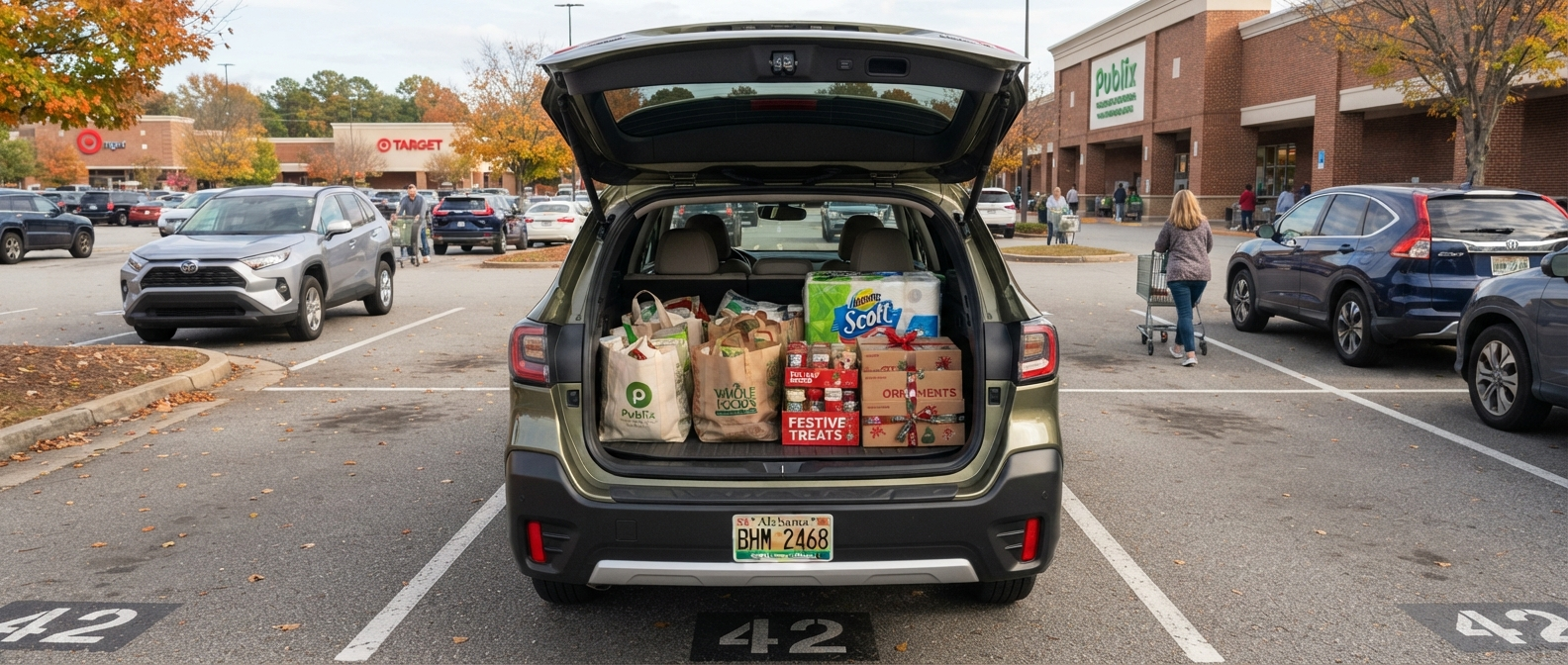
Both the Outback and the Forester handle a serious grocery run, so let's settle that up front. Which one fits YOUR run depends less on total cubic feet and more on the shape of what you're carrying. Here's the bottom line before we go further. The 2027 Outback wins on floor length and opening width, which matters for flat, bulky loads stacked side by side. Where the Outback runs wide, the 2027 Forester wins on cargo opening height, and that's exactly what you need when you're sliding in a case of drinks standing upright or a 36-count paper towel pack that can't be tipped on its side. Behind the rear seats, the cubic feet are nearly identical. The geometry is what this post is really about. And it isn't identical at all.
Will It Fit? The Cargo Dimension Breakdown
The two land closer together than the spec sheet headlines suggest, with Subaru listing the 2027 Outback at 34.6 cubic feet behind the rear seats and the 2027 Forester, without a moonroof, at 35.4 cubic feet, a gap you won't feel on a single grocery run. What you will feel is the shape of the opening when you try to shove a 40-pound bag of dog food through it.
Here's the actual geometry, pulled from Subaru of America's published specification sheets:
| Item or Load | 2027 Outback | 2027 Forester | Notes |
|---|---|---|---|
| Cargo behind rear seats | 34.6 cu ft | 35.4 cu ft (no moonroof) | Effectively tied for a full grocery run |
| Cargo with seats folded | 80.5 cu ft | 68.6 cu ft (no moonroof) | Outback wins decisively on full-fold |
| Cargo floor length, seats up | 42.8 in | Not separately published | Both carry standard grocery bags deep |
| Cargo floor length, seats down | 75.9 in | Not separately published | Outback has the longer flat floor |
| Cargo opening width (max) | 51.9 in | 43.3 in | Outback's wider mouth fits cases side-by-side |
| Cargo opening height | 34.1 in | 34.9 in | Forester's taller opening clears upright cases |
| Liftover height | 28.3 in | 28.9 in | Both are low; Outback is fractionally easier |
| Width between wheel housings | 43.3 in | 43.3 in | A standard water case fits both |
The spec that's easy to overlook here is opening height. At 34.9 inches, the Forester's cargo door clears a standard 12-roll paper towel package standing straight up. The Outback's 34.1-inch opening is close, but that extra 0.8 inches is the difference between sliding something in cleanly and having to tilt it and hope it clears. If your holiday list runs to bulk paper goods, tall boxed items, or cases of sparkling water you'd rather not tip, the Forester's opening geometry is the detail that decides it.
At 51.9 inches, the Outback's cargo opening runs nearly 8.5 inches wider than the Forester's 43.3-inch mouth. With seats up, you can place two full grocery bags side by side at the opening and slide both in at once without angling anything. And with seats folded, the Outback's 75.9-inch floor length is the longer flat run, the number that wins when you're doing the full costco-plus-liquor-store combo haul.
How to Load It
Loading strategy is where these two actually pull apart in practice, and the difference shows up less in the numbers than in the order you stack things once you've got the gate open and a full holiday cart waiting. Neither one leaves you stranded in a parking lot. But each rewards a different approach.
For the Outback, load flat and wide. That 51.9-inch opening means you can double-stack grocery bags side by side from the moment you open the gate. Heavier items like cases of drinks and a bag of ice go in first against the seatbacks, and light or fragile stuff goes toward the gate (where you can reach it without climbing in). The 28.3-inch liftover height sits around hip height for most adults, so there's no overhead heave. The 60/40-split rear seats fold in a single motion when you need the full 80.5 cubic feet. See what's in the current new inventory if you want to check which trims are on the ground right now.
For the Forester, load tall and sequential. That taller opening height is your friend for anything that can't be laid down, like a standing 24-pack, a holiday flower arrangement, or a gift box someone wrapped carefully. Load those items first, upright, against the seatbacks. Then slide shorter, denser items in front of them. The Forester's more vertical cargo proportions also mean a tall slow-cooker or a large mixing bowl fits naturally without the lid catching on the opening edge.
On our lot we also check how each car sees out the back. The Forester's boxy greenhouse and squared rear glass make backing out of a crowded Thanksgiving-week parking lot easy, so you're not guessing where the bumper sits when every lot between I-20 and US-280 is full.
- [ ] Measure your tallest single item before you shop (upright cases, flower arrangements, tall gift bags)
- [ ] If it exceeds 34 inches, test it against the cargo opening height before committing
- [ ] Outback: load widest items first and use the full 51.9-inch mouth to your advantage
- [ ] Forester: load tallest items first, upright, then fill in front of them
- [ ] Rear seats folding? The Outback gives you 80.5 cubic feet flat for the big runs
- [ ] Liftover is 28.3 in (Outback) or 28.9 in (Forester), both manageable without strain for a 40-pound load
- [ ] Heavier anchor items go against the seatbacks; fragile items go near the gate
- [ ] Cold and frozen items grouped together and covered
Job Done: Which One Wins Your Holiday Haul
Which one wins comes down to how you actually shop, so for a household feeding a crowd in one massive stock-up, meaning the full holiday pantry plus drinks, cleaning supplies, and whatever the in-laws requested, the Outback's 80.5 cubic feet of folded space and 75.9-inch floor run is the bigger tool for the job. It's the vehicle that fits what a minivan used to fit, without the sliding doors.
If your household does several targeted runs instead, you'll get more from the Forester's 35.4 cubic feet with seats up, its taller cargo opening, and its excellent rear visibility, which make it the more practical daily driver. Those targeted trips are the weeknight refill, the market trip with kids in the back seat, the Saturday where the rear seats are occupied by actual people most of the time. The gap in folded capacity between the two almost never shows up when the rear seats are in use.
The honest tradeoff is simple enough. The Outback is the bigger vehicle in every flat-cargo dimension, and it's also longer and slightly wider on the road. In the eastern suburbs, where school drop-off lines and parking decks are part of the weekly routine, some drivers find the Forester the more livable size day to day. Neither choice is wrong. They're calibrated for different versions of the same life.
If you want to put your hands on both before the holiday crunch hits, our team at Grants Mill Road can walk you through what's in stock and open both gates side by side.