
A real estate agent's workday in Birmingham doesn't follow a straight line. You might start at a listing in Irondale, run a client pickup near Mountain Brook, haul a half-dozen yard signs to a new property off US-280, and still need to look put-together when you open the car door at every stop. The right setup turns your Subaru into a mobile office that handles all of it without looking like a moving truck.
Up front, the 2027 Subaru Outback is the stronger pick for agents who routinely carry large signs, lockbox bags, and marketing materials, while the 2027 Subaru Forester earns its spot for agents who do a lot of client seating in the back and need a taller, easier-entry cabin. Both work, and the setup steps are almost identical. We'll tell you which choice makes the difference and how to configure either one for a full showing day.
Browse our current Subaru inventory to see what's on the lot right now.
What You Need Before You Start
Before you configure anything, know what you're actually fitting in the vehicle each day. A Birmingham showing day usually means carrying some version of this:
| Item | Typical Dimensions | Notes |
|---|---|---|
| Corrugated yard sign (18x24) | 24 in wide x 18 in tall | Stacks flat, slides in on edge |
| H-stake wire frame | Up to 36 in folded | Fits lengthwise in Outback; stands upright in Forester |
| Rolling lockbox bag | Roughly 12x12x18 | Needs stable floor space |
| Listing folder stack | Varies | Fits in a banker's box or document case |
| Soft-sided cooler (client amenity) | Varies | Goes in secondary zone |
| Spare shoes / umbrella | Small | Lives under cargo floor in both models |
2027 model specs that matter for this job:
| Spec | 2027 Outback | 2027 Forester |
|---|---|---|
| Cargo behind rear seats | 34.6 cu ft | 29.6 cu ft (Base) / 27.5 cu ft (other trims) |
| Cargo with seats folded | 80.5 cu ft | 74.4 cu ft (Base) / 69.1 cu ft (other trims) |
| Ground clearance | 8.7 in (std) / 9.5 in (Wilderness) | 8.7 in (std) / 9.3 in (Wilderness) |
| Power rear liftgate | Standard, all trims | Standard, all trims |
| EyeSight driver assist | Standard, all trims | Standard, all trims |
The Outback's extra seven cubic feet behind the rear seats is real. That's the difference between signs sliding in flat versus needing to angle or fold them. If you carry four or more yard signs in a single run, the Outback is the right answer. Full stop.
Setting Up Your Subaru for a Full Showing Day
The setup takes about fifteen minutes the first time, and after that it's a two-minute reload. Work through these steps once and the pattern sticks.
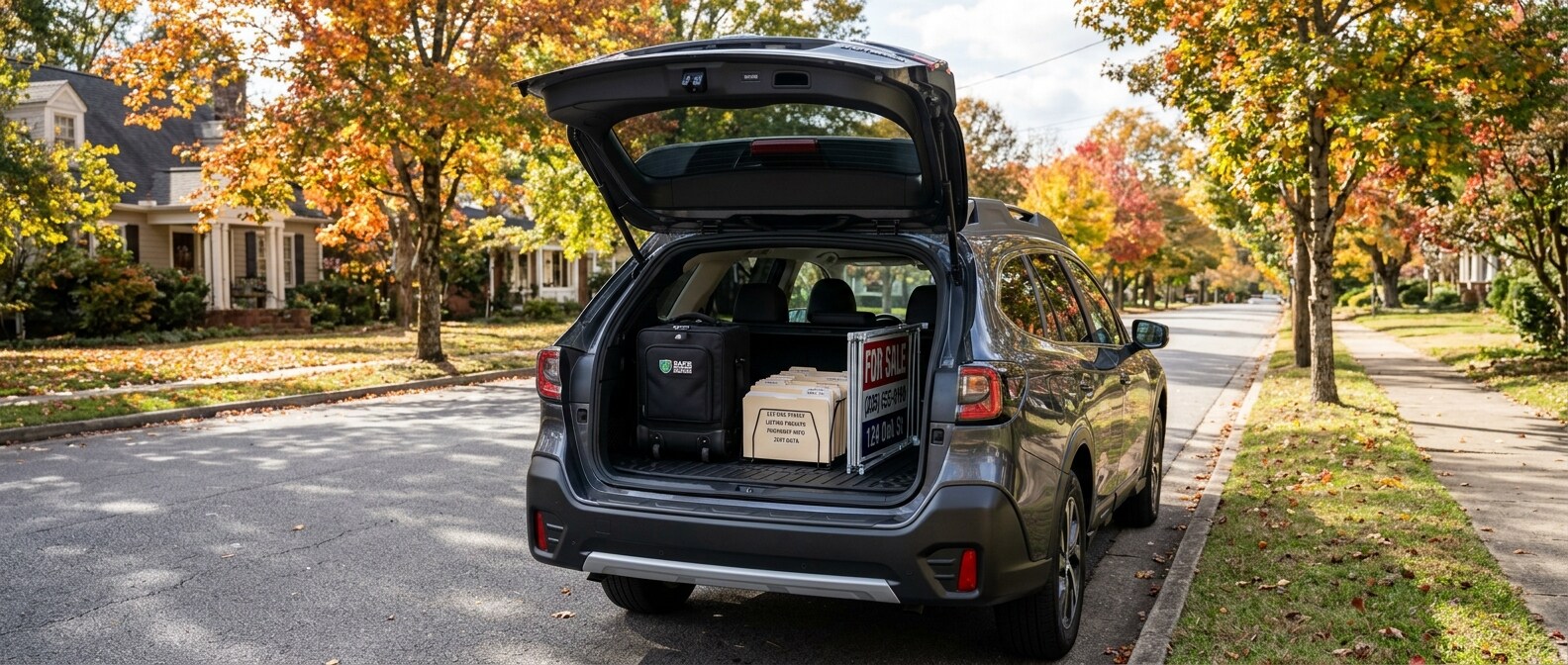
Step 1. Establish your two zones. The rear cargo area gets divided front-to-back. The front half (closest to the rear seats) is your clean zone: client folders, a document case, the soft cooler, anything a client will see or touch. From the liftgate inward is the working zone for signs, stakes, and the lockbox bag.
Step 2. Lay a cargo mat or rubber tray first. Both the Outback and Forester have a flat, low liftover. Slide a full-coverage rubber cargo tray in before anything else. It protects the floor, keeps items from migrating, and cleans with a garden hose after a muddy showing.
Step 3. Stand yard signs on their long edge, spine against the wheel well. In the Outback, 18x24 corrugated signs stand upright along the driver-side wheel well without touching the ceiling. Four signs fit side by side with room for the lockbox bag on the passenger side. In the Forester, the taller cargo opening makes this even easier to load, though you're working with less floor depth.
Step 4. Place the lockbox bag on the driver side, low and toward the liftgate. Weight low, toward the rear, keeps the bag from shifting during braking. The rolling handle folds flat. Anchored against the wheel well, it won't tip into your clean zone.
Step 5. Build the clean zone with a document case or lap desk. A slim hard-sided document case (legal or letter size) stores face-down across the clean zone. Set the client cooler on top of it. This stack stays below the rear headrest line, so back-seat passengers have full sight lines and don't feel like they're riding in a rolling filing cabinet.
Step 6. Use the rear seat pocket organizers for the client side. Both models have seat-back pockets deep enough for a full property packet, a business card holder, and a pen sleeve. Put those in before the first showing, not in the parking lot. See available Outback trims for the specific interior storage on each level.
Step 7. Run the EyeSight check. This one matters on a multi-stop day across Birmingham. EyeSight is standard on every 2027 Outback and Forester trim. It watches for the car ahead during stop-and-go on US-280, runs lane-keep assist, and applies pre-collision braking. The system works through the windshield cameras above the rearview mirror, so keep that area clear of signs, clings, or mount hardware that could block the camera field. Stick a suction-cup mount right in that zone and EyeSight will flag an alert.
Step 8. Follow the wet-day protocol. Birmingham's afternoon thunderstorms between June and September are fast and heavy. If you're doing a showing day in that window, add one step for a waterproof duffel that holds the sign stack. Corrugated signs absorb water on the bottom edge and warp within an hour, so slide them into a large nylon duffel before heading out. The power rear gate on both models opens hands-free when you have the key on you, which matters when you're carrying wet gear and don't have a free hand.
Outback vs. Forester for Real Estate Work: The Honest Call
The Outback carries more, and that's the beginning and the end of the cargo argument. At 34.6 cubic feet behind the rear seats (versus 29.6 in the Forester Base), it's the right tool for agents who routinely move physical marketing materials, open-house supplies, and multiple sign sets in a single day.
Where the Forester pulls ahead is the upright cabin and the tall, boxy glass area. Clients who are older or who have mobility considerations step in and out more easily. The seating position is higher. The visibility from the rear seat is better, which matters when you're giving a client a drive-through tour of a neighborhood and they want to look out the windows without craning.
The Forester gives up real cargo room. It runs about seven cubic feet tighter in the bay, and that doesn't sound like much until you're trying to fit a lockbox bag, four signs, and a banker's box on the same run. It adds up fast.
Our read on the Birmingham market: agents who work Mountain Brook, Irondale, and the US-280 corridor tend to list larger homes with longer driveways. They move more physical gear per showing day than agents focused on urban or condo-heavy inventory. For that profile, the Outback is the right fit. If your day is lighter on physical materials and heavier on client transport, the Forester is a genuinely good answer.
Both come standard with symmetrical all-wheel drive. That matters less for snow in Birmingham (which arrives once or twice a year and shuts things down regardless) and more for the wet, greasy pavement of an afternoon storm when you're accelerating off a driveway onto a hillside neighborhood street. Symmetrical AWD sends power to all four wheels continuously, which is what gives you the controlled pull out of a steep residential driveway after a downpour. See available Forester trims to compare seat and cargo configurations across the lineup.
A Print-and-Go Recap for Your First Setup Day
Walk through this before your first showing run:
- Rubber cargo tray or mat in place (full coverage)
- Clean zone loaded first: folders, cooler, client materials
- Physical divider (folded mat, cargo net, or blanket) separating zones
- Signs standing on long edge, spine against wheel well
- Lockbox bag low, against liftgate side of working zone
- Seat-back pockets stocked with property packets and cards
- EyeSight camera zone (above rearview mirror) clear of mounts or stickers
- Power rear gate memory height set for your lowest regular stop
- Waterproof duffel in cargo area June through September
That's the whole system. Schedule a service appointment if you're picking up a used Outback or Forester and want our team to walk through the vehicle settings with you before you go.
One note on the professional image question. Clients don't judge the nameplate, they judge the interior. A well-organized Subaru with clean upholstery and a cargo area that doesn't look like a junk drawer will read more professionally than a luxury badge on a vehicle that smells like old coffee and has loose papers everywhere. The setup is the signal.
Frequently Asked Questions
Does an Outback or Forester hold full-size yard signs without folding them?
Yes. The 2027 Outback's cargo bay is 42.8 inches deep from the seatbacks to the liftgate on most trims, and the width is generous enough to stand standard 18x24 corrugated signs on their long edge along the wheel well without bending. The Forester fits them too, but the shallower bay means you have less layering room. The Outback is the stronger choice for agents who regularly carry four or more signs at once.
Does the power liftgate work hands-free on both models?
Yes. The power rear gate on both the 2027 Outback and 2027 Forester opens with a key-fob gesture or via the vehicle's auto-sensing function when the key is on your person. On the Outback, the gate also has a programmable memory height so you can limit how far it opens when you're parked under a low carport or garage structure.