Most Birmingham winters stay mild. Then, with little warning, they don't. When a rare ice event rolls through, roads go from damp to impassable in a matter of hours, and the folks who end up sitting on a frozen overpass most of the night are usually the ones who figured "it won't be that bad this year."
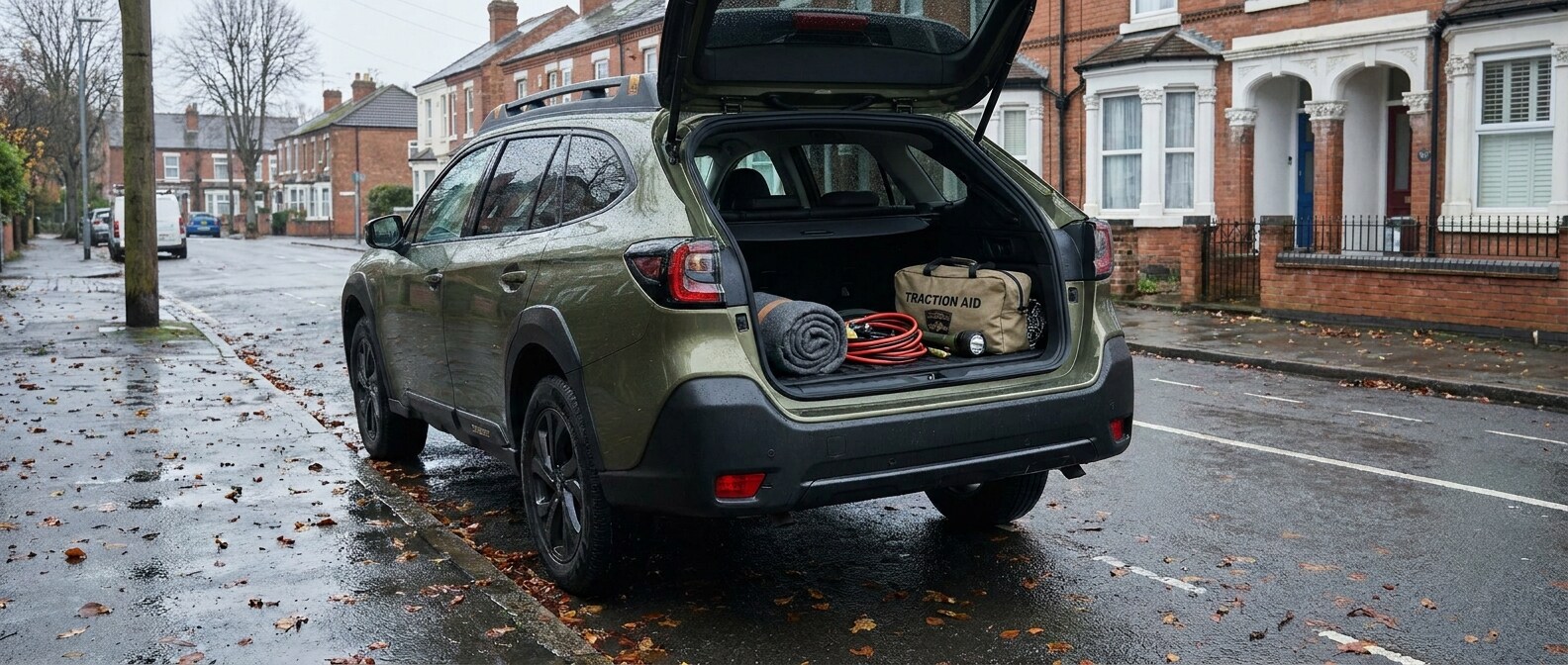
A single kit in the cargo area is the simplest preparation you can make. Here's exactly what to put in it.
The 2026 Subaru Outback carries 34.6 cubic feet behind the second row, according to Subaru's published specs. You can fit a full kit back there without eating into passenger space.
What Goes on the Alabama Winter Roadside Kit Checklist?
The right kit for Birmingham is short and focused, so you can skip the tire chains and the full sleeping bag and build instead around the real local risk, an ice event that might strand you on I-20 or I-459 for a few hours while overnight temperatures drop into the mid-20s and ALDOT crews treat the bridges. You probably won't need chains here. The threat is ice, so your packing should answer that.
Essentials. Have these in the car now, before a single forecast mentions ice.
- [ ] Jumper cables or a portable jump starter. Cold battery failures spike whenever temperatures stay below freezing overnight. A lithium-ion portable jump starter lets you self-rescue without a second vehicle.
- [ ] Flashlight with fresh batteries, Or a hand-crank model so battery condition never matters.
- [ ] First aid kit. Bandages, antiseptic wipes, gauze pads, adhesive tape. NHTSA lists this as a core winter vehicle item.
- [ ] Mylar emergency blanket (at least one per person). These pack flat and retain body heat. The Red Cross includes them in both its basic survival kit and its family first aid kit.
- [ ] Phone car charger and a backup power bank. Your phone is your navigation, your roadside assistance call, and your connection to emergency alerts. Keep both.
- [ ] Reflective warning triangles (3). Triangles are safer than flares on a roadway with other sliding vehicles. Set one at 100 feet, one at 300 feet, one right behind the car.
- [ ] Water (at least one day's worth per person). Birmingham city guidance recommends at least three days of supply in a home kit. For the car, one full day per person is a realistic minimum.
- [ ] Non-perishable snacks. Granola bars, nuts, dried fruit, peanut butter packets. Just enough to stay comfortable for several hours, not to stock a pantry.
- [ ] Basic tool kit. Pliers, an adjustable wrench, a flathead and Phillips screwdriver. Multi-tools count.
- [ ] Tow strap. Useful if someone else needs a pull or if you're waiting on a service call and want to give them something to work with.
Alabama-specific additions. These reflect what actually happens here.
- [ ] Ice scraper with a long handle. You'll use this more than any other cold-weather item. Birmingham freezes happen overnight, and you'll walk to a car with a fully glazed windshield.
- [ ] Bag of non-clumping cat litter or sand, for traction under tires on a slick patch when you need to move a few inches forward. This is the most underrated item on any Southern winter kit list.
- [ ] Warm layers and gloves stored in the car, a dedicated set beyond what you're wearing that day: wool or synthetic socks, a knit hat, an extra pair of gloves. If you have to get out to handle something, you'll want them.
- [ ] Windshield washer fluid rated to freeze below 0 degrees Fahrenheit. Standard summer fluid freezes in the nozzles. The ALEA (Alabama Law Enforcement Agency) specifically lists this in its winter vehicle guidance.
- [ ] Paper copy of emergency contacts, because when your phone is at 3% and you can't charge it fast enough, a printed list of numbers matters.
- [ ] Small fire extinguisher (Class B/C rated). Rarely needed, but it takes up almost no space and covers electrical fires, which can happen when vehicles sit running in the cold.
Schedule a Pre-Winter Service Check
Why These Items Matter for Birmingham Specifically
A Southern ice event behaves differently from a Northern snowstorm, and that difference is exactly why this kit is built the way it is. Deep snow rarely buries you here. Instead a thin, hard layer of ice forms on roads the region hasn't pre-treated, because nobody builds a road-salt fleet for two events a year.
The 2026 Subaru Forester, like every Subaru in the lineup, comes standard with symmetrical all-wheel drive, which helps traction under acceleration. What it can't do is change how ice interacts with your stopping distance. The road still decides. So the kit still matters.
The bridge problem is real. ALDOT officials confirm that bridges and overpasses ice over first, because cold air circulates both above and below the elevated surface at once and drops the pavement temperature faster than the roads around it. The I-20/I-59 interchange through Birmingham runs elevated for long stretches. So does I-459 on the south side. In any freezing event, those structures can glaze over before the approaching roads show a hint of trouble.
The warm-ground effect makes it worse. For the clearest local example, look back at the 2014 Snowpocalypse. In the days before, temperatures sat near 60 degrees and warmed the ground. When freezing air moved in and snow fell, that first layer melted on contact with the warm pavement and then refroze into a sheet of ice, per National Weather Service Birmingham's documented review. The sequence, not the total snowfall (which was only 2 to 3 inches), is what turned I-20 into a parking lot and left tens of thousands of people stranded.
Build your kit around the realistic scenario. You're on a bridge on-ramp during a morning commute, moving isn't safe, and you need to stay comfortable and visible for somewhere between two and six hours.
The cat litter note deserves its own paragraph. Of the two traction aids, sand works as well as the litter. Sprinkle either under a drive wheel and you get enough grip to rock a vehicle forward a few inches on a slight incline when you're nearly stopped. You don't need much. A five-pound bag takes up no room, so keep it aboard.
| Item | Why it matters for Alabama winters |
|---|---|
| Portable jump starter | Cold nights drop battery voltage; self-rescue without another vehicle |
| Non-clumping cat litter or sand | Traction aid for tire spin on ice patches, more practical than chains here |
| Mylar emergency blanket | Compact warmth for a stranded wait; Red Cross standard kit item |
| Ice scraper (long-handled) | Overnight glazing is the most common Alabama ice scenario |
| Freeze-rated washer fluid | Standard summer fluid freezes in nozzle lines below 32 degrees Fahrenheit |
| Reflective triangles (3) | Elevated visibility on icy roads where other vehicles may also be sliding |
| Backup power bank | Phone-dependent navigation fails when the battery does |
| Warm layers stored in car | Not what you wore to work; a dedicated extra set |
| Water (one day per person) | Birmingham city guidance is three days at home; one day covers a roadside wait |
| First aid kit | NHTSA winter vehicle guidance includes this as a core item |
The 2026 Subaru Ascent deserves a mention if you're hauling a family of four or more. It carries the most passenger volume in the Subaru lineup at 153.2 cubic feet, which helps when you're fitting kit items around three rows of occupants and gear.
Print-and-Go Recap: Your Alabama Winter Roadside Kit
Here's the full list in one place, grouped so you can print it, walk out to the car, and put a checkmark next to each item as it goes into the cargo area. Print it, check every item, and put a checkmark when it's in the car.
Core safety items
- [ ] Jumper cables or portable lithium jump starter
- [ ] Flashlight (fresh batteries or hand-crank)
- [ ] First aid kit
- [ ] Mylar emergency blanket, one per regular occupant
- [ ] Reflective warning triangles (3)
- [ ] Phone car charger
- [ ] Backup power bank
- [ ] Tow strap
- [ ] Small Class B/C fire extinguisher
Alabama climate-specific items
- [ ] Long-handled ice scraper
- [ ] Non-clumping cat litter or sand (5 lb bag minimum)
- [ ] Freeze-rated windshield washer fluid (rated below 0 degrees Fahrenheit)
- [ ] Warm layers stored in the car (hat, gloves, extra socks)
Comfort and communication
- [ ] Water (one day's worth per person)
- [ ] Non-perishable snacks
- [ ] Paper list of emergency contacts
- [ ] Basic tool kit (pliers, wrench, screwdrivers)
A good time to build this kit is right after your winter service appointment. Fresh battery, checked tire pressure, topped fluids. Then the kit goes into the cargo area and stays put until spring.
Book a service appointment now, before the first ice forecast makes a slot harder to find.
Frequently Asked Questions
Does an Alabama winter kit need tire chains?
Probably not for Birmingham metro driving. Chains earn their keep when you're in sustained snow cover or on steep mountain grades where snow piles up and stays. Around Birmingham, the winter risk is usually a sudden ice event that melts within a day or two as temperatures rebound. Chains are a pain to install and unnecessary for the scenario you're most likely to face. A bag of cat litter or sand, paired with all-weather tires in good shape, is the more practical choice for the city and the surrounding corridors.
How often should I check and refresh the kit?
Check it twice a season, once at the start of winter, with November a good target, and once more in mid-January, since that's when Alabama's most significant ice events tend to hit. Focus on three things each time. First, battery condition on the jump starter, or replacement of jumper cables if they've corroded. Second, freshness of the water and snacks, and toss anything past its expiration date. Third, the temperature rating on the windshield washer fluid, which you may have swapped out during the warmer months. Everything else keeps indefinitely if it's stored in a cool, dry cargo area.