

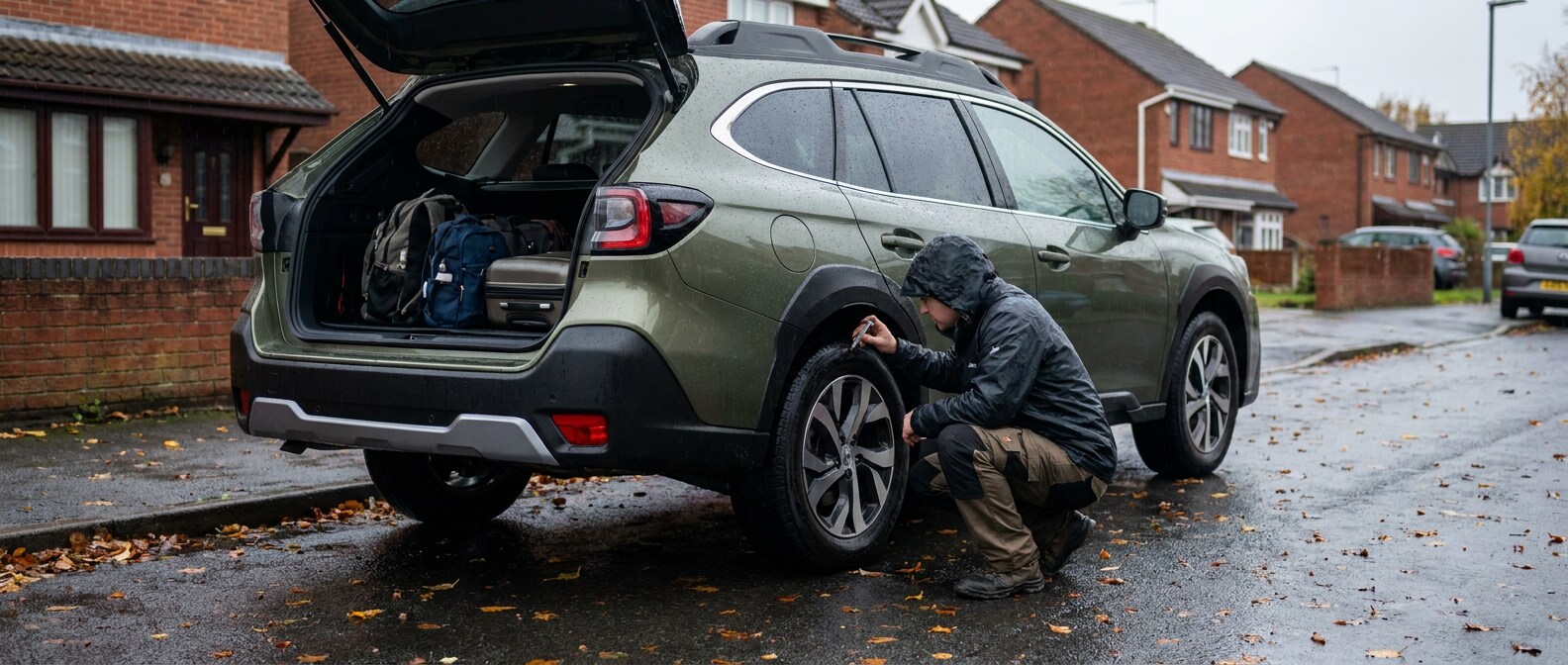
Your tires are the only part of your Subaru actually touching the road. Everything else rides on them, the Symmetrical All-Wheel Drive, the EyeSight suite, the confident handling you've come to trust. Four patches of rubber carry all of it. Before you load the car for Thanksgiving or Christmas, run one tire check that every Subaru owner should do, and know it differs a bit from what a generic pre-trip list will tell you.
Subaru's Symmetrical AWD is built around all four wheels turning at nearly the same rate. Mismatched tread depths can stress the center differential in ways that show up as an expensive repair, not a minor inconvenience. Most holiday travel checklists leave that Subaru-specific detail out entirely.
The 2026 Subaru Outback and its siblings head south and east on I-20 all Thanksgiving week. Our service team runs through the following before we let one leave the lot without a clean bill of health.
- Tread depth floor for Subaru: plan to replace all four when any tire reaches 4/32", not the 2/32" legal minimum. To maintain AWD system health and wet-road grip.
- Pressure by model (cold, before driving): Outback 35/33 PSI front/rear; Forester 36/35 PSI; Crosstrek 33/32 PSI. November temperature swings drop about 1 PSI per 10 degrees Fahrenheit.
- The Subaru-specific rule: all four tires must stay within 2/32" of each other in tread depth. One new tire on a half-worn set can damage the drivetrain.
- Sidewall and age: check for cracking, bulging, or any tire more than six years old regardless of remaining tread.
- Spare: confirm it's inflated to the spec on the driver's door jamb before you leave Birmingham, not in a rest-stop parking lot in Tennessee.
What Actually Matters When Choosing Tires, and When to Inspect Them?
Four variables decide whether your tires are ready for a holiday run, and they are tread depth, inflation pressure, sidewall condition, and the Subaru-specific one, which is how evenly the four tires wear relative to each other. If you pass the first three and miss the fourth, the AWD system still pays for it.
Most general checklists stop at the penny test. That's a fair start, but NHTSA identifies 2/32" as the legal minimum tread depth. For wet roads, 4/32" works better as a threshold, because at that depth water can channel through the tread grooves instead of pooling under the contact patch. Birmingham's November averages around 15 rainy days. I-20 and I-59 heading east toward Irondale stay wet for days at a stretch after a cold front rolls through. None of this is hypothetical weather.
The Subaru-specific piece changes the calculation.
| Check | What to look for | Subaru-specific threshold | Tradeoff |
|---|---|---|---|
| Tread depth (each tire) | Penny test shows Lincoln's whole head = replace; quarter test shows head = at 4/32", consider replacing | All four tires within 2/32" of each other | Waiting until 2/32" (legal minimum) risks AWD drivetrain strain if tires wear unevenly |
| Inflation pressure (cold) | Outback: 35/33 PSI front/rear; Forester: 36/35 PSI; Crosstrek: 33/32 PSI | Check the driver's door jamb for your specific trim | Pressure rises 2-4 PSI after driving; always measure cold |
| Sidewall condition | No bulges, cuts, or visible cracking | Same as any vehicle | A clean sidewall can hide internal damage after a pothole hit |
| Tire age | Date code on sidewall (four digits: week + year) | Six years is a common service guideline regardless of tread depth | Rubber degrades; tread depth alone doesn't tell the whole story |
| Spare | Inflated per door jamb spec; compact spares typically 60 PSI | Compact spares on many Subaru models require AWD deactivation; check your owner's manual | A spare that's flat is useless at mile 300 on I-65 |
Schedule a pre-trip tire inspection with our service team before the holiday rush builds. Appointments go fast in the week before Thanksgiving.
The 2/32" AWD Rule Is the Part Most Checklists Skip
Tread uniformity matters more than any single gauge reading if you own a Subaru with Symmetrical AWD, which is effectively every Subaru on our lot, because the system is built to spin all four wheels at nearly the same rate and it treats any mismatch as slip it has to correct.
The word "symmetrical" earns its keep right there. When tread depths differ across the four tires by more than 2/32" of an inch, the tires carry different rolling circumferences. The center differential reads that as continuous wheel slip and works to compensate. Keep that up over a long holiday drive, and you're piling strain onto a component that won't broadcast its unhappiness until the repair bill lands.
The Subaru Forester owner's manual states the four tires should be the same size, brand, construction, and tread pattern, and warns that using tires with different levels of wear can damage the drivetrain. The specific limit published by Subaru is a tread-depth difference of no more than 2/32" between any two tires.
Practically, that plays out one way. If one tire is worn and needs replacement while the other three have significant life left, you can't just swap one. A brand-new tire next to three half-worn tires creates exactly the circumference mismatch the manual warns about.
The 2026 Subaru Forester and the 2026 Subaru Crosstrek are the two models on our lot where uneven front-to-rear wear tends to sneak up on owners, less about neglect and more about all-season tires wearing unevenly when rotation intervals get stretched.
Pressure Is the Fix That Costs Nothing
Inflation is the cheapest ready-your-tires step you've got, and it drifts on its own as the weather cools, because Birmingham's average first freeze lands around November 9, per the National Weather Service, and tire pressure falls roughly 1 PSI for every 10 degrees Fahrenheit the temperature drops. Drive out of Birmingham at 60 degrees, hit the Tennessee hills at 40 degrees, and your tires have already lost 2 PSI before a single mile of highway flexion adds to it.
Inflation specs for 2026 Subaru models (cold, measured before driving or after at least three hours parked):
| Model | Front PSI | Rear PSI | Note |
|---|---|---|---|
| Outback (all trims, standard tires) | 35 | 33 | Verify on driver-side door jamb for your specific build |
| Forester | 36 | 35 | Door jamb is authoritative; some trims vary |
| Crosstrek | 33 | 32 | 225/55R18 trims same as 225/60R17 trims |
| Ascent | 33-35 | 33-35 | Door jamb required; load affects rear spec |
Always read the door jamb sticker rather than the number molded into the tire sidewall. The sidewall figure marks the tire's maximum capacity, which is a different thing from your Subaru's recommendation. Keep them straight.
One real tradeoff comes with cold checks. You'll need a few minutes in the morning before your first drive of the day. Fill up at a gas station after 20 minutes behind the wheel, and the reading runs 2-4 PSI high, so you'll ride underinflated while thinking you're set. It's a small timing discipline, and it's the one that works.
Schedule a Pre-Trip Tire Check
Match the Gear to How You Actually Drive
The right tire condition for a holiday trip out of Birmingham depends less on raw mileage and more on where you're headed and how the car's been driven, so a set that feels perfect on a flat interstate run can come up short on a mountain grade even with plenty of tread left.
Route stays on I-20 east toward Atlanta, or I-65 north toward Nashville? All-season tires in solid condition handle Alabama and Tennessee winter conditions comfortably. Snow is rare here. NWS Birmingham data shows the city averages about 1.6 inches of snow per year total, and the median date for first measurable snowfall is January 20. Cold rain, fog, and the occasional freezing rain event are what you actually get, hitting precisely because this region isn't ready for it. Good tread at the right pressure is what serves you there.
Heading into the mountains instead, the Smoky Mountains, western North Carolina, or anything on the Blue Ridge Parkway in December? Tread depth becomes more important here, and all-season tires with strong tread ratings hold up considerably better than worn ones regardless of their three-peak mountain snowflake (3PMSF) rating.
The 2026 Subaru Ascent loaded with family and luggage puts more weight over the rear axle than an empty car. The door jamb spec accounts for that, but a recheck after loading is worth it if you're already running close to the recommended rear PSI.
A quick note on sidewall age. The DOT date code on the tire's sidewall gives you the manufacturing week and year. A tire built in week 24 of 2020 reads "2420." Six years from manufacture is a common service benchmark for replacement, regardless of remaining tread depth. Rubber degrades from heat cycles and UV exposure even when the tread looks fine. If you're not sure how to read the code, our service team can do it in about 30 seconds.
Frequently Asked Questions
Do I really have to replace all four tires on a Subaru at once?
Not always, though the threshold is tighter than on most vehicles. Subaru's Symmetrical AWD system wants all four tires within 2/32" of each other in remaining tread depth (and within about 1/4 inch of rolling circumference). If you need to replace one tire and the other three carry more than 2/32" of additional tread compared to the new one, the system is running mismatched, and replacing all four becomes the standard recommendation to protect the center differential. If the other three sit close to the same wear level as the new tire, replacing in pairs or all four comes down to how close the numbers really are. Measure with a gauge rather than eyeballing it. When in doubt, bring it to our service team and we'll give you the exact tread readings before you decide.
What tire pressure should I use for a Subaru Outback or Forester in cold weather?
The 2026 Subaru Outback calls for 35 PSI front and 33 PSI rear on cold tires. The 2026 Subaru Forester calls for 36 PSI front and 35 PSI rear. Verify against the driver-side door jamb sticker for your specific trim and tire size, since some configurations vary. Check pressure before driving in the morning, or after the car has sat for at least three hours. For every 10-degree Fahrenheit drop in outside temperature, your tires lose approximately 1 PSI, so a cold front that pulls temperatures down 20 degrees overnight can leave you noticeably underinflated before you've even left the driveway.