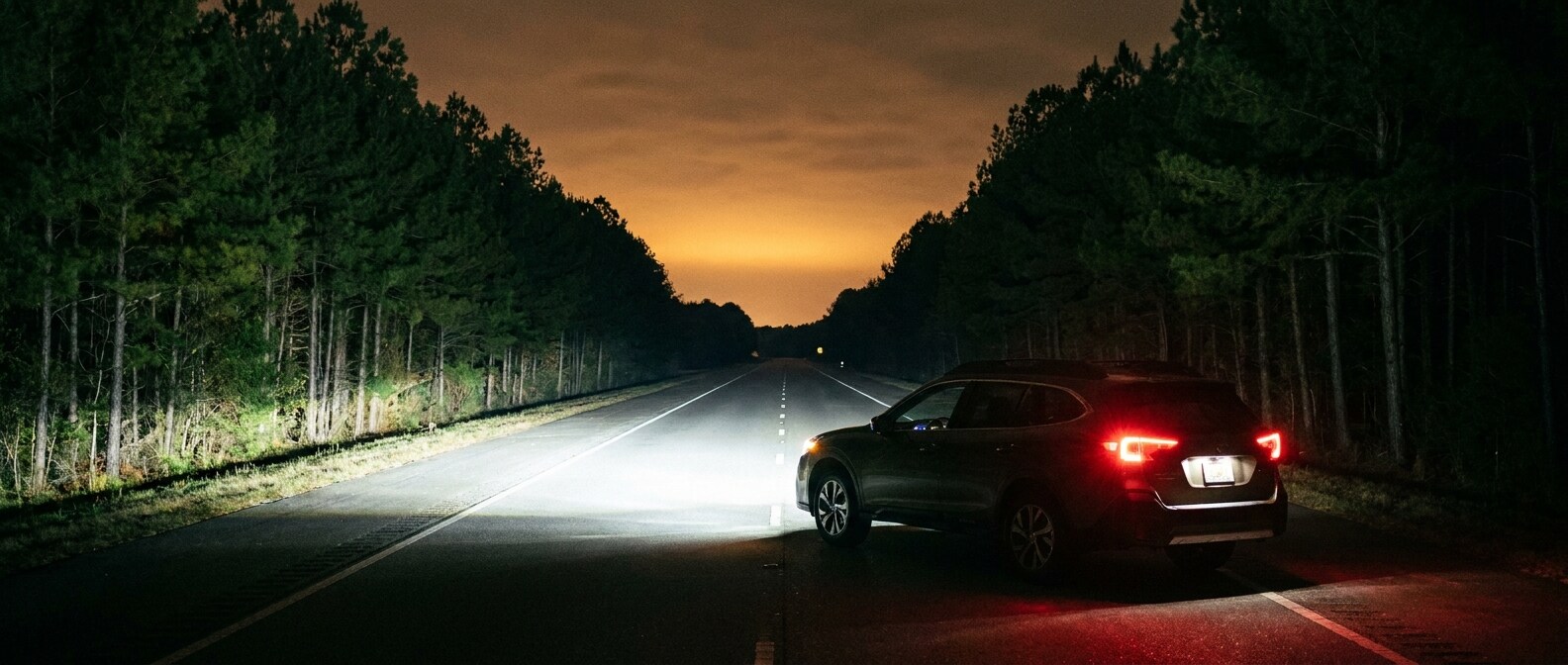
Long stretches of I-20 and I-459 run completely unlit, and that's not opinion. The City of Birmingham and ALDOT have been chipping away at this infrastructure gap for years, and local news has covered it plenty. Drive those corridors after dark and your headlights are the only light source for a big chunk of your commute. Add November's deer movement season through the wooded corridors east and south of the metro, and after-dark driving here carries specific demands that most car-buying conversations skip.
A fair question before the dark season sets in is which Subaru handles night driving best, and the answer comes in two parts. All three family models (the Forester, the Outback, and the Ascent) come standard with EyeSight, LED Steering Responsive Headlights, and High Beam Assist on every trim, and where they differ is in sensor architecture, cab height, and which expanded EyeSight features are standard versus optional, all worth knowing before you sign anything.
- All three models include EyeSight, LED Steering Responsive Headlights, and High Beam Assist standard on every trim level.
- The 2026 Outback's EyeSight is the most upgraded of the three: three forward-facing cameras plus newly added radar sensors, per Subaru's published press materials.
- The Forester's taller greenhouse and larger glass area give the driver the best unassisted sightlines of the group, before the technology even activates.
- The Ascent's elevated seating position and wider body are the advantage on two-lane roads where deer movement is highest, now through January.
- Pick based on your route type and how many seats you need, not on which name sounds most capable.
For a solo commuter or a small family, the Forester is the clearest starting point. See the 2026 Forester on our lot and decide which trim fits your budget and your route.
How Do These Three Models Actually Compare for Night Driving?
Side by side, all three share the same headlight hardware and High Beam Assist, so the separation shows up in the sensor stack and the body geometry, which is exactly what the table below maps out instead of just listing feature names that come standard versus the ones you pay for.
| Feature | 2026 Forester | 2026 Outback | 2026 Ascent |
|---|---|---|---|
| LED Steering Responsive Headlights | Standard, all trims | Standard, all trims | Standard, all trims |
| High Beam Assist | Standard, all trims | Standard, all trims | Standard, all trims |
| EyeSight sensor setup | Stereo forward cameras | 3 cameras + radar sensors | Stereo forward cameras |
| DriverFocus (drowsiness + distraction) | Select trims | Standard, all trims | Select trims |
| Blind-Spot Detection | Select trims | Standard, all trims | Standard, all trims |
| Standard airbag count | 7 | 8 | 8 |
| Ground clearance (non-Wilderness) | 8.7 in. | 8.7 in. | 8.7 in. |
| Best night-driving fit | Urban commute, tight parking | Dark interstate, long nightly runs | Full family, rural two-lane |
What separates them most is the Outback's sensor architecture. For the redesigned 2026 model, Subaru added radar sensors alongside three forward-facing cameras, which gives the system a redundant check a stereo-camera-only setup can't replicate when overhead lighting is gone. Forester and Ascent run Subaru's proven stereo-camera EyeSight. All three work well. In full darkness, though, the Outback's setup has a genuine edge.
Does Your Specific Route Change Which Model Is the Right Call?
Yes, your route changes the answer more than the badge does, because a car tuned for long unlit interstate runs isn't the same pick as one built for tight wooded two-lanes, and most buyers don't weigh that until they're already behind the wheel.
Your night driving is mostly I-20 east toward Irondale or the consistently unlit sections of I-459. The 2026 Outback was built for exactly that. Its three-camera-plus-radar EyeSight suite gives the system a secondary input when the overhead lights are gone. High Beam Assist activates at or above 20 mph and switches automatically to low when it detects an oncoming or preceding vehicle's lights, per Subaru's published owner documentation. So you're running high beams more of the time without ever reaching for the stalk. The 2026 Outback's LED low beams reach a measured peak of 386 feet, which puts them in the 86th percentile among tested SUVs and crossovers in published lighting performance data. On a genuinely dark road, that's a real number.
Your routes run more on two-lane county roads east and south of the city, through wooded stretches where visibility closes in fast. The 2026 Ascent and the Forester both bring something the Outback can't match in that environment: a higher seating position. Height changes your sight angle over roadside brush and embankments, which buys you a fraction more reaction time before the car's sensors engage. You won't find that in any spec sheet. Taller body geometry simply does that to your field of view.
Alabama wildlife officials and state transportation agencies both note that deer and other wildlife movement near Birmingham peaks through the fall and winter months, with animals crossing road edges in the evening and early morning hours. The rut runs roughly October through December, so it's happening right now. High beams are your most effective tool on those unlit roads, and High Beam Assist takes the manual switching off your plate when another vehicle shows up.
So does EyeSight see in the dark the way your headlights do? Not quite. It relies on cameras, and camera-based tech performs best in well-lit conditions. Subaru's published owner guidance is direct about it, noting that performance can be limited in complete darkness or severe weather. EyeSight assists with lane management and pre-collision braking. It won't alter your stopping distance. Your headlights and your tires are still the primary tools.
Schedule a Pre-Winter Safety Check
Night-Driving Pros and Cons at a Glance
| Pros | Cons |
|---|---|
| Forester: Best unassisted sightlines (tall greenhouse, largest glass area); lightest and most maneuverable; IIHS Top Safety Pick+ for 2026 | Forester: Stereo-camera EyeSight, not the three-camera-plus-radar suite; smaller cargo (27.5 cu ft behind second row) for gear-heavy trips |
| Outback: Three-camera-plus-radar EyeSight; DriverFocus and Blind-Spot Detection standard on all trims; 8 airbags; redesigned 2026 platform; 386-ft low-beam reach | Outback: Longer 191.7-in. body is less agile on tight city streets; no hybrid option on this nameplate |
| Ascent: Highest seating position; elevated sight angle over roadside brush; 8 airbags; 260 hp turbo for confident full-load driving | Ascent: Largest footprint and lowest fuel economy of the three; turbo adds running cost on longer commutes |
Picking the Right One for How You Actually Drive
Picking well comes down to matching the car to your route and your seat count rather than the name on the tailgate, so here's how our team walks a shopper through the three based on how the miles actually break down over a week.
Commuting solo or with a small group, mostly city and suburban routes with some unlit interstate. The Forester is the practical answer. Its tall greenhouse and low beltline give you the best unassisted sightlines of the three, and it's the most maneuverable in traffic. The Insurance Institute for Highway Safety recognized the 2026 Forester with a Top Safety Pick+ award, its 19th consecutive TSP recognition, more than any other small SUV in IIHS's own published record. EyeSight is standard. High Beam Assist is standard. It does the job.
You put real miles on the car, run a steady mix of dark interstate and secondary roads, and want the strongest sensor suite from the base trim up without stepping to a higher package. An Outback fits that situation. DriverFocus, which uses an infrared camera to watch for drowsiness and distraction, is standard on every 2026 Outback trim, not just the upper ones. For a driver covering real distance on consistently dark roads, that across-the-board availability is the detail that sets it apart from the other two. Our service team can also walk you through EyeSight calibration if you pick one up and want to know what the system's doing on your commute.
You move a full family regularly, often in the evening, on a mix of lit suburban streets and darker two-lane routes. The Ascent is built for that. Same High Beam Assist, same EyeSight, eight passengers, plus the elevated seating position that helps on those darker stretches. Subaru's published specifications list the 2.4-liter turbocharged engine at 260 horsepower. It moves a full car without asking the engine to strain. The tradeoff is real, though. It drinks the most fuel of these three, and no amount of careful driving changes that.
Whatever model you're leaning toward, do one thing before the season gets any deeper. Check your tires. EyeSight helps with lane management and reaction time. It won't change the distance it takes to stop. Stopping distance comes down to tires, speed, and road surface. If your tread is marginal, that gap opens up faster than you'd like, and no driver assist closes it.
Frequently Asked Questions
Does EyeSight perform the same at night as it does during the day?
Not exactly. EyeSight uses forward-facing cameras as its primary sensing layer, and cameras work best in well-lit conditions. Subaru's published owner documentation is straightforward on this point: performance can be limited in complete darkness or severe weather. The 2026 Outback addresses part of this by pairing its cameras with radar sensors, giving the system a redundant input when overhead lighting disappears. For all three models, the most practically useful night-driving feature on Birmingham's unlit roads is High Beam Assist, which is standard on every trim. Per Subaru's published owner's manual, it activates at or above 20 mph and switches automatically between high and low beams when it detects oncoming or preceding vehicle lights. EyeSight is a support layer. Your headlights, your tires, and your attention are still the primary tools.
Do I need a higher trim to get High Beam Assist on the Forester, Outback, or Ascent?
No. High Beam Assist is standard on the base trim of all three models, per Subaru's published trim comparison specifications for each nameplate. The same applies to LED Steering Responsive Headlights. Where the trim level starts to matter for night driving is on features like DriverFocus and Blind-Spot Detection. On the 2026 Outback, both are standard across all trims. On the 2026 Forester and 2026 Ascent, those features arrive on select trim levels. If driver drowsiness detection is a priority for your longer evening commutes, factor that into which trim you are evaluating.